
[Terug naar Wijn is Fijn]
[*** In ontwikkeling; vooralsnog verzamelplaats van tekststukjes ***]
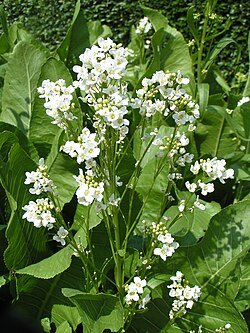 Over de smaak/aroma(‘s) van mierikswortel. Liefst in relatie tot wijnen waarin we sporen ervan menen te herkennen.
Tot nu toe vond ik geen enkele beschrijving in ‘standaard aromawiel’termen of dergelijke. En toch geeft de mierik (sic; Armoracia Rusticana ook wel Cochlearia armoracia) méér dan alleen een prikkelende sensatie. Eens zien of een start-in-doortrekkend-tot-contrast-met mosterd, in dezen enig soelaas of vertrekpunt kan bieden. De Grote M is immers familie, qua plant; mierik produceert ook mosterd-olie… Idem wasabi (‘Japanse Mierikswortel” jawel! Eutrema Jaopnicum) ernaast te houden. Nu je het zegt..? Dan zeg ik het maar – want ook broccoli, kool en radijs horen in deze familie; niet echt bijdragend aan de aromabenoeming hè? En we moeten wel zorgen verder te komen dan alleen ‘sinigrine, gyconasturtiine en / leidend tot allyl-isothiocyanaat (hé da’s pure mosterdolie daar hebben we ‘m) die kennen we wel maar het is te smal, teveel op één beentje hinkend.
Oh hee deze kende ik tot voor heel kort (minuut geleden) nog niet: https://aromawheel.net/!
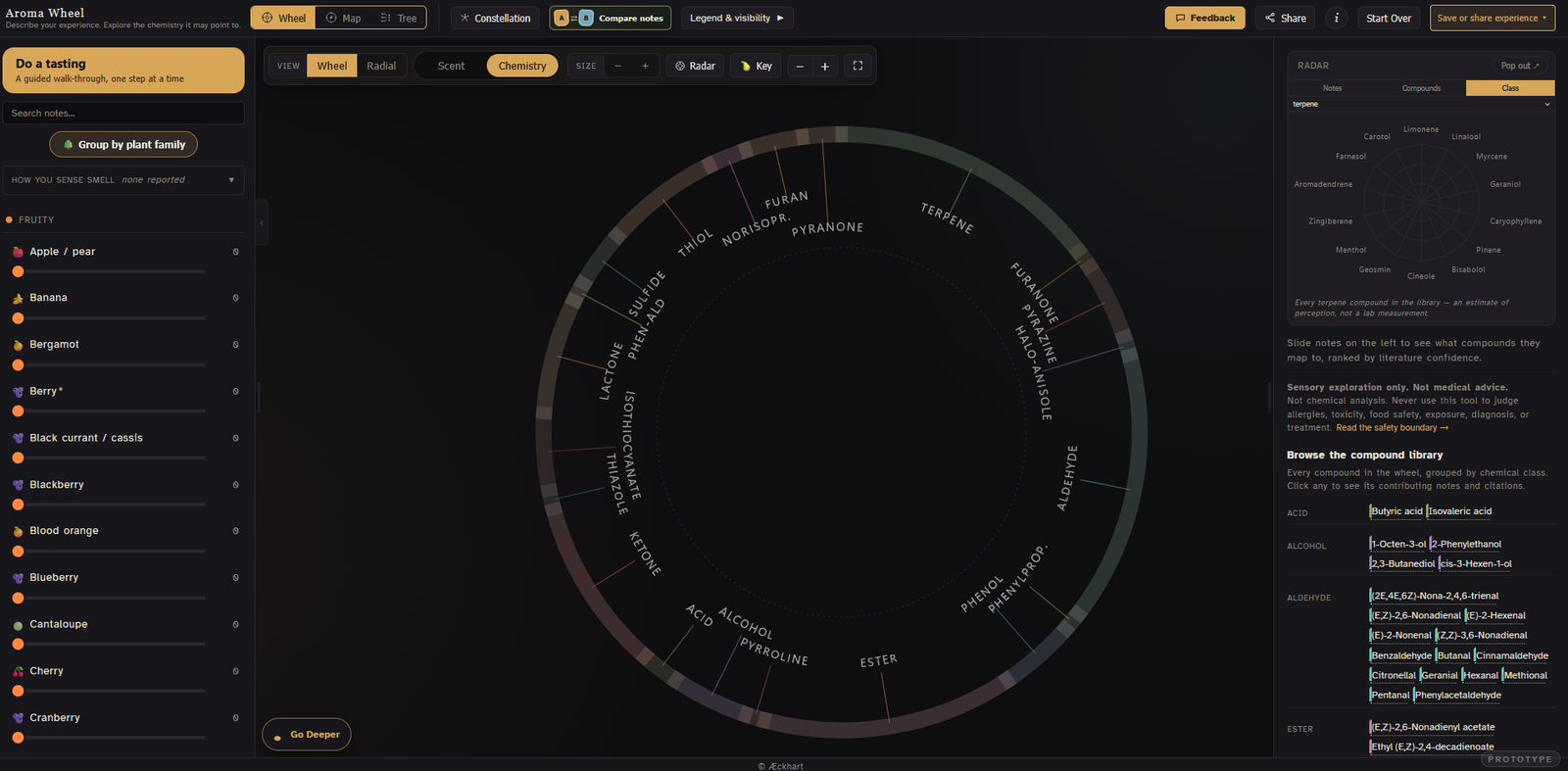
En daar vinden we onder andere, jawel:
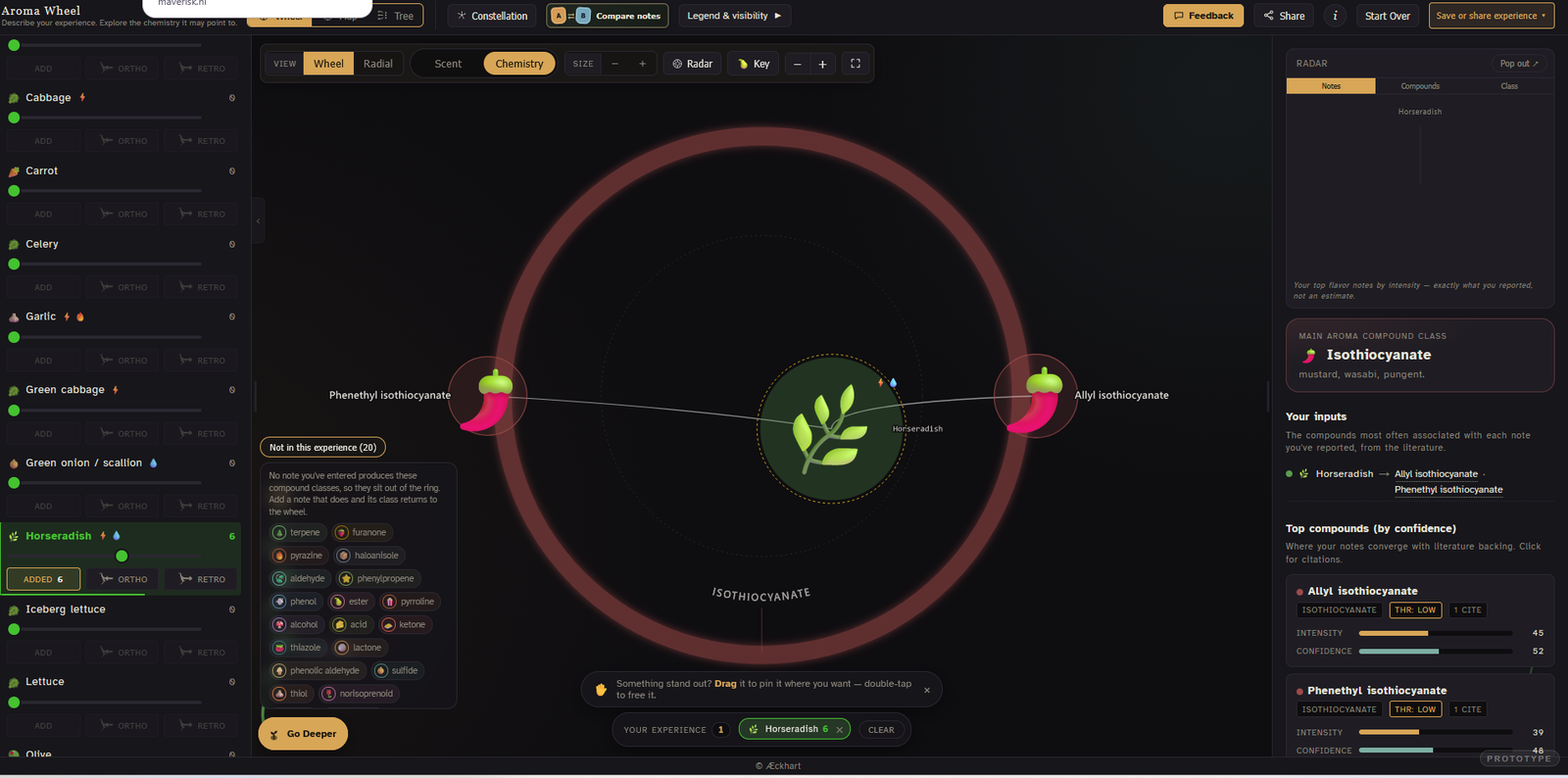
Nou, dan zijn we Done, toch ..? Hoewel … Het is duidelijk dat het niet alleen om ortho- of retronasale dingen gaat hier, de trigeminale zenuw wordt ook flink geraakt met prikkeligheid en branderigheid, het is ‘pungent’, ‘âcre’ – welke afbraakproducten van het thyiocyanaat hebben we het dan over?
En de aroma’s zijn in de praktijk zeker niet precies hetzelfde als van mosterdolie dus er ontbreekt nog het een en ander. Ook is (echte) wasabi wat complexer en ‘groener’, mierikswortel eensmakiger maar wel juist wat scherper!
Amounts of isothiocyanates and related compounds in a mustard extract and a horseradish extract for food additive use were determined by GC, after confirmation of the identity of GC peaks by GC/MS. Amounts of allyl isothiocyanate, which included that of allyl thiocyanate, because most of the allyl thiocyanate detected in the sample was assumed to have been formed from allyl isothiocyanate during GC analysis, were 97.6% and 85.4%, in the mustard extract and the horseradish extract, respectively. Total amounts of the identified isothiocyanates in the mustard extract and the horseradish extract were 98.5% and 95.4%, respectively. Allyl cyanide, a degradation product of allyl isothiocyanate, was found in the mustard extract and the horse-radish extract at the levels of 0.57% and 1.73%, respectively. β-Phenylethyl cyanide, a possible degradation product of β-phenylethyl isothiocyanate, and allyl sulfides were found in the horseradish extract, at the levels of 0.13% and 0.46%, respectively. Allylamine, which is another degradation product of allyl isothiocyanate, was determined after acetylation, and was found in the mustard extract and the horseradish extract at the levels of 8 μg/g and 67 μg/g, respectively. Ik wilde hier verder op ingaan maar de rest van het artikel was nét buiten bereik van m’n roestige (nonh-existente!) begrip van Japans…
Low mass volatile components in the hydrolysate of Wasabia japonica, Brassica juncea, and Cocholearia armoracia were determined by gas chromatography-mass spectrometry. In the hydrolysate of Wasabia japonica, the following 10 volatile components were detected : Methyl, isopropyl, allyl, sec-butyl, 3-butenyl, 4-pentenyl, 5-hexenyl, hexyl, 6-heptenyl, and β-phenylethyl isothiocyanates. Volatile components of Brassica juncea comprised 11 kinds as follows : Methyl, isopropyl, allyl, sec-butyl, butyl, 3-butenyl, 4-pentenyl, phenyl, 3-methylthiopropyl, benzyl, and β-phenylethyl isothiocyanates. Volatile components of Cocholearia armoracia had 8 kinds as follows : Isopropyl, allyl, 3-butenyl, 4-pentenyl, phenyl, 3-methylthiopropyl, benzyl, and β-phenylethyl isothiocyanates. From these results, it was decided that the volatile components of above three materials had different isothiocyanates.
En laten we niet vergeten dat, ondanks dat de bewijsmarges dun blijken, er toch steeds weer onderzoek wordt gedaan naar allyl-isothiocyanaat als (alleen preventieve?) bestrijder van onder andere borst- en blaaskanker.
Each May, horseradish is celebrated at the International Horseradish Festival in Collinsville, Illinois. Events include a root toss, a horseradish-eating contest and a horseradish recipe contest. Beginning in 1988, the festival was designed to create national awareness for the herb and the area where most of the world’s supply is grown, according to festival organizers. Collinsville and the surrounding area is part of what is known as the “American Bottoms”, a Mississippi river basin area adjacent to St. Louis. Carved-out by the glaciers from the ice age, the soil is rich in potash, a nutrient on which the horseradish thrives. The area grows 60 percent of the world’s supply. German immigrants to the area began growing horseradish in the late 1800s and passed their growing methods from generation to generation. The area’s cold winters provide the required root dormancy and the long summers provide excellent growing conditions.
[Terug naar boven]