51%-attacking democracy

Suddenly, the similarities dawned on me, between latter-day ‘democratic’ governments and the blockchain’s 51%-attack ideas.

  • A 51%-attack on a blockchain is that when (not if) one controls 51% (as in: a majority) of the votes needed to ‘certifiy’ a certain transaction on the blockchain, you basically have captured Truth decisions and can change transactions at will, because you will agree with yourself (51% of votes have it) that your alterations are valid.
    If you need more info on how blockchain (voting) works: here.
  • A 51% attack on democracy would be where some party/potentate is able to coax a majority of voters, or rather of their representatives, into believing that their well is best served by following the Leader. This will protect the Leader from recourse against the (indicative for all) morally and ethically utterly unjust, fraudulent, unconstitutional and like decisions (in absentio or not), acts and speech acts (including flat-out lying, bullying, threats et al.), and goat trailing through just and equitable law (where they should be the penultimate protectors of that!), since no-one is able to stop him (not her, in general; exceptions apply). All the things a proper government (morale) and constitutional structure should systemically protect against. The ones to stop him, best serve themselves by not protesting; they profit. And they can’t be replaced quickly since that would require them to (majority)vote against themselves and even then. And in due time, the loss of systemic protection will be written into law. Look around the world; through the explosion of near-timefree communications, the bug has spread at record pace, on all continents.

Yes, that is the definition of mob rule. In the former case, at least a true majority (though probably commandeered by a handful) might benefit. In the latter, the voters are ousted of their constitutional powers to correct. I.e., democracy isn’t anymore, dictatorship remains.

Solutions?
Not many. Revolution (in its post-1789 understanding*) is one. But not a structural solution as such, only making room for a possible one – what comes after?
* Since before, it was the natural turn of events over the centuries that were recognised to be the wheel of fortune turning over types of governments as well. Democracy being (one of?) the most decrepid form of organising societies, remember?
And pointing out to the compliant accomplices that their benefits are all too temporal and they’re just pawns, e.g., by pointing to this (title) and explaining that it may not be their children but they themselves at whim’s notice, but these are too stupid (no less derogatory word needed) to understand.

It’s more the inherent flaw of democracy, as decried by all men (sic) of mind that considered it, throughout (the ages of) humanity. We’re back at ☐ one. When even the most thoughtful spirits of mankind haven’t been able to solve this, what can we do?
Apart from studying Bruce’s latest (at time of this writing), at least. Book review of this, here above (in Dutch).
And what solutions do blockchain thinkers have against 51%-attacks? We might learn.
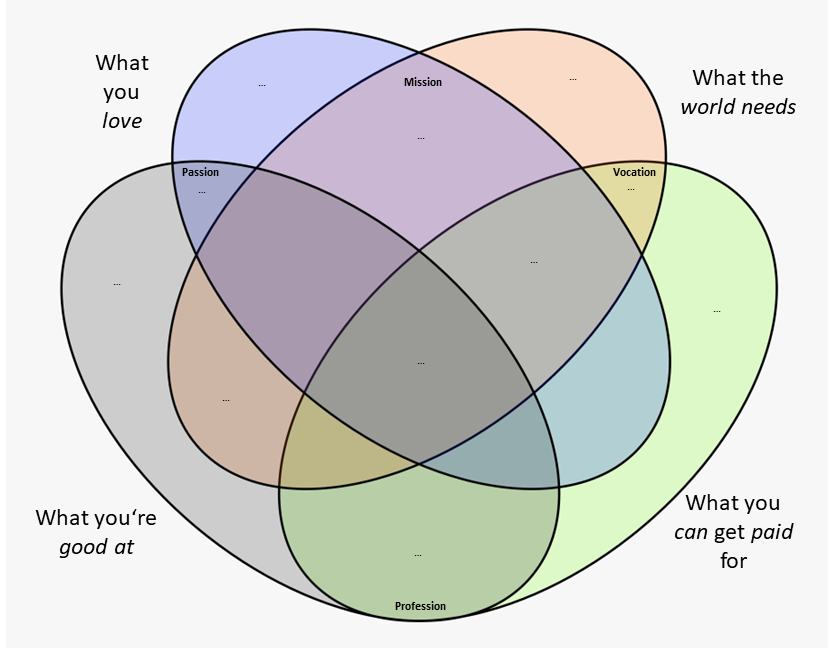

Nikigai – How to four-way Venn and find your optimal life

… Yes dear reader that isn’t misspelled. Traditional Ikigai charts are incomplete as they aren’t proper four-way Venn diagrams.
Because the latter require all overlaps to be in the pic. Like, 4-way, all 3-way, and all 2-way overlaps. The latter, a Problem.

Behold:

Where you can fill in the ‘…’ to your liking. And then find ways to move all that you just entered, towards the middle. Preferably over the ‘paid’ wing(s) if you can, or over the others, if you prefer to keep something strictly as a hobby.

But do note the lack of labelling of many (overlap) areas; those are the ones not (depicted or labelable now that I used it that is a word) in the original.

Have fun!

Yup, once again. Since today’s that date.

As an intermission: Would you know which is which, of the above/below …?
And then, there’s continental differences …

[Since it’s today’s date, I thought to flip it and not be original just for one day… nevertheless, the day deserves some sillyness in particular in current circumstances. See also the two previous Today’s Date posts.]

First up, the Elk:
elk-06
Servus Canadensis, the wapiti indeed. Next up, the Elk: Continue reading “Yup, once again. Since today’s that date.”

Latest physical → cyber ..?

Just when one thought that the War in the cyberzz would be fought with all the conventional tricks of wiperware and integrity corruption (i.e., dis- and mis-information, dirty patches), there pops up [yesterday] a news item about Alexander* using EW/flare pods as ‘co-payload’. As determined by e.g., GW Herbert.

Now, at what pace would we see this tactic be deployed also in cyberspace [if that exists] ..?

Why wouldn’t a payload as dropped into/onto some network, not only use legit UIDs for further reconnaissance, priv escalation et al., but also create fake ‘innocious’ accounts that would at some point be ‘found out’ and removed, only to declare the network fully safe again? So that the real payload could fly on to its target. Should be doable. May not be extremely difficult to create some new defenses against, but hey, another piece to the arsenal ..? Another piece of defense you need to build (or at least design) to be ready when certain stuff hits the fan?


[These sort of perimeter defenses will also not work. ‘Perimeter‘… Note that any army that seriously tried, did conquer England – maybe not the other parts as much.]

* As all of you are very aware, the missile ‘name’ actually is Iskander. Which is the derogatory name all the peoples conquered by The Macedonian used and use. So, either they don’t know about this and feel proud [for that’s what such missile names commonly are chosen for] for a ridiculous reason, on their way to prove the name is used by the defeated, crushed; or they do know that with the name they side with the oppressed – not reflecting current mil actions – and the name reflects their instinct of the fate that they will lose big-time.
Or, in revenge for some field trip in Asia in the area where even Alexander did fail eventually, the trip that worked out the same as those that came after [and those that came after, in the 20th C, didn’t learn a thing from their precursors; even more stupid! See this book. But then again, those that came after in the 21st C, they were the really stupid not to have learned…], they chose the name in prep for regaining control in that (wider) area with a “If you insult us (?) with that slur, it will backfire on you” weapon. I’m getting away from the main subject of this post a bit, eh?

AutoAuto’s blijven een droom

Tsja, auto’s, ‘artificial intelligence’ en security: Het is het bekende verhaal. Nog steeds … Zijn er technologische of andere ontwikkelingen de afgelopen halve eeuw waarbij security-in-brede-zin nou eens echt vanaf het begin is meegenomen, of blijven we met alle OT-dingen om ons heen doorgaan met de put dempen, security er een beetje (sic) opschroeven als het al te laat is?
Bij auto’s is dat ook het geval. Met als complicatie dat we niet alleen snel de auto omvormen tot softwareplatform op wielen1, maar gelijk ook het geheel liefst zo volledig mogelijk zelfrijdend willen maken. Zelfrijdend, in de chaotische context die het wegverkeer is. De mogelijkheden en oplossingen kennen drie grote issues, die in een drieluik van hoofdstukken aan bod zullen komen: Wat kan de mens en wat kan de auto, potentieel; waarom pakken we het niet aan met centrale aansturing of coördinatie en; wat kunnen we dan wel – waar staan we nou eigenlijk met aai-oplossingen? Dit stuk, het zal niet verbazen, bestaat net als Gallia2 uit drie stukken.

Soort-van waarschuwing: Dit is een longread…

Deel 1: Goto HumanDriver Considered Dangerous

Hier pakken we dus de eerste vraag op. Met vooral aandacht voor een element uit het ‘system’ dat we of het nu homo ‘sapiens’ is of HAL, in de auto de functie heeft van Central Scrutiniser3: De Bestuurder. Wat kán die, hoe beslist die ..?

De meesten van u zullen het wel hebben meegekregen; het resultaat van een groot onderzoek van MIT4 over beslissingen die een Moral Machine zou moeten nemen om aan te sluiten bij wat wij mensen moreel handelen vinden. Nou ja, het ging eigenlijk alleen over een klein, bekend onderdeeltje van moreel redeneren, het trolley problem. Waarin de keuze moet worden gemaakt om een of meerdere mensen om te brengen, om een of (nog-)meerdere anderen te redden. Een besluit is verplicht, nietsdoen is een keuze voor een van beide alternatieven. [Al is onduidelijk wat de default instelling is in dit experiment…]

Uit het onderzoek kwam van alles naar voren – dat er over de wereld gezien culturele verschillen zijn in de statistisch ‘ideale’ keuzes. Dat het nogal uitmaakt wat er precies aan binaire alternatieven voorhanden is. Dat het uitmaakt wie je het vraagt; ja man/vrouw, jong/oud dat geeft allerlei verschillende maar moeilijk voorspelbare antwoorden. Dat was nog enigszins voorspelbaar. En dat de resultaten desondanks een zware bias hebben doordat de deelnemerspopulatie stevig leunde naar man, hoger opgeleid, welvarend en dus waarschijnlijk meer kosmopolitisch (en dus mogelijk minder religieus), en sowieso deelnemend. Dat soort beperkingen aan de representativiteit worden wel vermeld maar de impact op de resultaten niet (voldoende). Waarmee we dus niet weten of de resultaten bij voldoende biascorrectie wellicht grijs middelmatig vlees noch vis zouden zijn5. Zoals bij de debatten onder ethici over dit soort zaken: Er wordt fraai gedebatteerd en wat was het een interessante uitwisseling van argumenten en filosofische uitgangspunten – maar een eenduidige, snel beslisbare oplossing komt daar nooit uit. Als het probleem in de praktijk zo Onbeslisbaar6 lijkt, dan kunnen we misschien beter ophouden.

Morele Auto’s
Dat het onderzoek beperkt was (is) tot het trolley problem, maakt de resultaten nou ook niet bepaald geschikt voor praktijkgebruik bij bijvoorbeeld zelfrijdende Auto’s7. Die Auto’s zullen heus in veel situaties terechtkomen waar wel meer dan twee alternatieve wegen voorwaarts zijn. Dat er wordt geleerd van de praktijk, is niet noodzakelijkerwijs een oplossing, of beter. Neem het geval van de overstekende voetganger met fiets aan de hand – de Auto herkende dit te laat (als obstakel) om nog rustig te kunnen remmen. De Auto had geleerd om vooral niet te gemakkelijk tot remmen te beslissen omdat bumperklevers al zo vaak schade gaven aan de achterbumper; dan maar liever gewaagd om door te rijden tot het echt niet anders kan oftewel het te laat is voor een noodstop. Exit voetganger. Tsja, economische argumenten gaan nu eenmaal voor.

Dat was eigenlijk al duidelijk toen bleek dat Auto’s veel defensiever reden dan mensen; er was kennelijk nogal wat te processen aan informatie en better be safe than sorry – voor de Auto’s en de verzekeringsmaatschappij … Hetgeen overigens de ruimte schiep (schept?) voor fervente Automobilisten om dan nog veel meer plezier te beleven aan hun hobby, maar dat terzijde8. Post scriptum: De Auto’s zullen dus langzaam rijden, ook al om een andere reden9 – zie ook 75.
Continue reading “AutoAuto’s blijven een droom”

Eindeloos projectfalen

[English version below]
U vergat te leren. Dus ging uw project de mist in.

[Dit is een repost-plus-een-beetje van 2018. Omdat er kennelijk niets, naar boven afgerond nul [uitzonderingen daargelaten; oprechte felicitaties] veranderd is in de loop der jaren. Decennia. Hoewel er met ‘Agile’ wel ietsje voortgang is bereikt, hier en daar daar sprints [sprintjes; geen manier om een marathon van een infrastructuurvernieuwing te bereiken, overigens] als micro-projectjes kunnen gelden.]
[Merk tevens op dat waar ‘project’ wordt genoemd, ook ‘programma’ kan worden gelezen.]

Aan alle project-gerelateerde functionarissen: Deed u wel de Evaluatie aan het eind van uw vorige project? Serieus?? Uitgebreid en diepgaand genoeg om potentieel nuttige informatie over ups en downs en near-misses en hoe die laatste twee te voorkomen te hebben voor toekomstige projecten? Echt? In al uw vorige projecten?
‘Ja’ is nogal ongeloofwaardig.

En, waar eindigde die informatie in projecten die u later deed?

Nergenshuizen, ongetwijfeld. Alleen in de projectmanagementtechnieken en -methoden die in de opzet- en planningsfase extreem veel detail vragen (deze is daarbij het lezen, stukbestuderen waard) komt het nog weleens voor.
Daar lezen we soms (niet eens altijd) nog wel eens een vage notie van het meenemen van het geleerde uit vorige projecten (een beetje zoals hier).
Maar dat zijn uitzonderingen. In standaarden met tonnen aan detail. En dan wordt lessen meenemen alleen aangeduid in de inleiding. Als u dat al volgt.

Gewoonlijk – weest eerlijk! – … zelfs dat niet echt. Pino of NePino. Tsja maar dan, zoals op de lagere school tot en met ‘woordjes leren’…:

Lessons will be repeated until they are learned.

Jawel, zelfs indien (sic; als niet wanneer) auditors uw project management aan de start van een project checken om te bepalen of de opzet succes überhaupt mogelijk laat – en ze mee blijven lopen met de projectuitvoering om passend risicomanagement en -control in het project aangaande project governance [don’t get me started], voortgang, en de andere helft van het auditwerk: de kwaliteit van de deliverables richting de oorspronkelijke doelstellingen,
zelfs dan wordt daarbij nooit achtgeslagen op toezicht dat de juiste en toepasselijke lessen die uit vorige projecten zouden moeten zijn geleerd, worden meegenomen. Dus zowel de voorkoombare fouten, vergissingen en onachtzaamheden als de succesvolle risicoreducerende acties. Áls u auditors dat wel deden en doen: mijn hoogachting. Die dus op nul blijft hangen.

Simpele conclusie: Om uw toekomstige projecten een kansje te geven succesvol te zijn, zijn de lessen uit het verleden verplicht te worden meegenomen aan en vanaf de start.

En eis dan ook van auditors dat ze daar toezicht op houden; mede bijvoorbeeld door auditors de schuld te geven van projectfalen als ze risico’s en voorkoombare fouten niet tijdig [dus aan en vanaf de start] signaleren en laten oplossen.
[Waarbij terzijde dat de ooit niet zo serieus genomen Gateway Reviews bij overheidsprogramma’s in potentie invulling gaven aan zulk toezicht. Wellicht niet juist gericht en met niet de volle omvang en diepgang, maar toch.]

Nu dan, om u op te vrolijken:

[Is ook een visie; Porto]

Eternal project failure

You failed to learn. You’ll fail your projects.

[This, as a repost from 2018. Since nothing seems to have changed; exceptions excepted [true congrats]. Though with ‘Agile’ [the schmagile; more on that in later posts] things have improved just a little, here and there, as sprints might be considered micro-projects..?]
[Note, too, that wherever ‘project’ is mentioned, ‘program’ certainly applies as well.]

To all project management related types: Did you do your Lessons learned session at the end of your last project? In earnest? Extensively and deep enough to be potentially useful in future projects? Seriously? In all your previous projects?
Experience and statistics don’t agree with any Yes.

And, where did the lessons learned show up in the projects you did later?

Nowhere, I guess. Only where project set-up standards require the most excruciating detail in planning and activities – the kind that no-one will follow in practice (this is strongly recommended to be studies to pieces, as illumination). There, we sometimes (not even always) encounter some vague reference to do include past projects’ learnings (bit like this).
But that’s the exception. In the full-detail standards. Qua guideline at the outset.

Common practice (be honest) … not so much. Pino or NePino. Well, …

Lessons will be repeated until they are learned.

Yes, even if (sic) auditors check on your project management at the start, to see that the project is well set up to achieve the objectives – and auditors stick along with project execution to track proper risk control in the project re project governance, progress, and the other half of audit work the deliverables – hardly ever does that cover checking that all the right and applicable (…) lessons learned from past projects (both the preventable errors/slip-ups and the successful risk mitigation actions) are in fact included in this new project under study. If you auditor did do this, than congrats and hats off to you!

Simple conclusion: To greatly enhance your future projects’ chance of success, include past learnings in earnests.
And require auditors to do the same when they audit projects, e.g., by putting the blame on auditors when projects fail at known, mitigatable risks, for their lack of due and timely advice.

[Edited to add: Which may tie in easily with the ‘required’ (by me) project pre-mortem analysis as per this.

Now, to cheer up:

[Use your Vision; Porto]

Decryptioners: Please chip in

[Since I don’t have the appropriate tools at hand…]
Remember I posted this, about two major historic Question Marks that are still out to be solved and how maybe the ‘AI’ community could reach out and prove their worth?

There’s more. Like, here:
+ Voynich [Isn’t this a class?]
+ Oxyrhynchus 90 [Guess there’s a great many others, too]
+ Charley and Hetty [Not the CSI one, … on second thought might be the same (age)]
+ Dorabella
+ Pigeon NURP 40 TW 194 [Deserves a better name, ‘Nurpy’ ..?]
And this list may be augmented. Any suggestions ..?

Yes this is again a call for humanity-serving research by aspiring [is the key word] young [of mind!!] intelligence/crypto analysts that want to become Prominent through an [I think] extensive combo of straight-on crypto analysis with not much to work on and no cleartext, history with scant [operational-detail level] evidence to paint [autonotsocorrect turned that into Paint but that’s quite another Nobel Prize worthy invention] a context, and multi-method evidence gathering and multifaceted analysis methods. A bit like real analysts’ life. Pascal’s Wager on the existence of the latter.
Would love to see e.g., stego analysis, too. ‘No milk traces ..?’

Or just use it as generic analyst training assignments and see what they come up with. If nothin: whatev’, they’ve learned to try and not succeed: a valuable lesson. If by any chance they’d find something: great!!
Though I doubt whether I’d want to live in a world where every unknown gets known. Too disenchanting. Luckily, politician’s brains are/create ever more unfathomable mystery qua ways of not being sane. I’ll stop now. You start cracking!

In the mean time, for your viewing pleasure:

[Unedited; suitable agencies and their students not too far off from here, right?]

NAIvier-Stokes’y solutions

Haven’t studied it yet, but it seems that this has finally been ‘done’, in this
Navier-Stokes, one of the ones that was apparently unsolvable [in a final form type of way], now has “AI” solutions.

Yeay!

And

[Would make an ideal remote-office; just North of Siena]

Straight-Through-RPA ..?

Correct me if I’m wrong [… dear reader, if there is any one] – I seem to have missed in the brief on RPA:

  • It generates human position (fte-replacing) point solutions for workflow automation for transactions that can be interpolated in the training set(s), doing very little in the full stretch of Straight-Through Processing (yes I happened to have been around in the ’90s/’00s) or at max taking it step by step;
  • It does nothing for ‘outliers’ outside the training set(s) as these are doomed to be mistreated;
  • Happenstance circumstances may fill the training set(s) but clarity re seasonal patterns, specific (marketing et al.) actions, etc., is missing;
  • Clarity re the correctness of transactions (often screen-scraped) for the training set(s) is lacking;
  • When taken in a series of sub-implementations, may help in STP;
  • RPAAI (Unassisted RPA, with (only now?) an ‘AI’ component) may go just a little further but not much [as per above].

Not a problem, if one is a consultant selling this stuff. A problem,

  • When not if one is to be replaced (in total, or for a major part of one’s job) by some API contraption
  • OR when one’s dependent on less-than-perfect implementation and hence outcomes for one’s free life (the AI bias issue again, buried / token/scapegoat human)
  • OR when one’s a concerned member of society seeing already waaay too much sh<third-person pronoun> being automated with too little reason compared to the crippling (to be) dependence on brittle automation. Because it’s brittle by design, being designed by humans to be optimal for the situation in the blip of the moment that it was [designed].

Shall we pull this and this out of the bag, maybe?
Oh, and this:

[Oh really; Salz’ again ..?]

Maverisk / Étoiles du Nord