An Economist is Wrong

And I don’t even mean one of those that think descriptive science can turn into normative science in a twitch.
I actually mean an Economist article. This one.
[Edited to add a week later: vindict]

Q: Why was oil so valuable? A: Because it took money to produce, and supply was limited – both at any moment and in total global possible availability; even if almost all of the earth consisted of oil, it would still be a finite physical amount with exponential production costs. The oil you burn, is lost forever so even your current stock perishes – though the value is maintained in the stock you have, so not (intrinsically) lower in time.
Q: Why is data considered valuable? A: Because some stupid didn’t see that supply is endless, and any physical limits hardly apply – data is losslessly [nice word] copyable and producable into infinity, at costs that decrease over time, too. And the value of data decreases exponentially with time, against which ‘enrichment’ only helps in the short term. Who cares what you did some little while ago? [Any criminal act of yours lapses in due time, and that same category of acts by politicians (i.e., many of their acts), too. Just give it enough time and their acts might even turn into heroic acts – the few ones that aren’t forgotten that is.] Even for advertisers, the great paycheck writers qua ‘data’ when discussing value, will hardly care what you did last Summer. It’s like money with presses at full speed, plus ever more presses being put into production – like here.

So, …
Either work on value retention, or on the decrease of production [Hey, you know, privacy ..!? Yes data minimisation will increase the value of what you do keep],
or …
Go out and create as much data as you can, as quickly as possible, and take care to inject sufficient amounts of random noise. Bury the profilers.

Oh well; let’s enjoy:
[Even in the midst of Haut Koenigsbourg, one finds pumpkin spice latte’s godmother. Oh wait.]

Note: In-fosec-centives

‘Because’ that’s not a word yet. But one might miss this presentation here, at one’s loss – if only for the return of this little gem:
It is difficult to get a man to understand something when his salary is dependent on his not understanding it. [Upton Sinclair Jr]

If only, not only, semantics [i.e., the things that actually matter, not syntax as much – excepting code where things seem to be in the inverse!], we have many important talking points. Like, nudging solutions [on a scale from true nudges, small and isolated, all the way to supernudges, big blows on many dimensions as society is so complex little local nudges will meet resilience], and the above
that is oh so very true for all sorts of situations in organisationland. Like risk management, that is in its so very required overhaul it seems. Maybe make full and all salaries dependent on change, then you may achieve a little. Privacy, the same [though it is but a subset of infosec that needs the changes anyhow] – nudging, or making the wanted behaviour the easiest [creating resistance against the less-wanted behaviour] already played a sideline role there but wasn’t operationalised enough yet.

Yes one feels a sledgehammer is needed against the incumbents, the crazy ones.

Oh well. Check out the pres, and:

[Great for a museum, to protect the inside. Organisations need to go out, not stay in; Vienna]

Will the AI hype go on(to) Evolve next ..?

After the generic-AI hype will have slowed, and actual generic AI of the Normal kind gets integrated into society big time / you ain’t seen nothin’ yet time, what ..?

Apart from a huge spread of more ML algo’s than the mere Bayesian and non-linear regression (e.g., this one that I tested in a thesis already back in 1994 – it worked even when I had the feeble cpu power of the day),
And apart from the return of Expert Systems, since when the above start to become analysed everyone realises that is what ML does, on a big scale but still,
let me propose:

Evolutionary (genetic) algorithms.

Which is mentioned in this overview, I believe to recall – I’m human, and perfection is boring.
But not enough. Strange, when one considers how effective these are, and how e.g., ‘quantum computing’ actually is only a massively-parallel implementation of this.

To Be Continued …
[Already post-schedule, pre-release: this]
Plus:

[Ah, as designed by evolutionary Nature… was temporarily my Martinique off-site working office… (cabin just off the beach there)]

You’re so non-compliant …!

Since you don’t have the real chapters in place. Not even on paper.

Since those initial chapters of just any standard you can dream of (Alptraum, you know) have the essence, the principle-based stuff. Whereas the latter ‘chapters’ of any standard regard guidelines or even-mere examples for the lazy, of what needs to be done after those initial chapters are working effectively.
Yes, a lot of you may jump directly past the fluff to the annex that has some of the things you understand. The penny-wise stuff. ISO 27001 as a prime example I happen to work with every now and then. Others apply, certainly.

Since for very sure, it is the first few chapters that describe the processes that you need to have (sine qua non), to even be able in the most basic form, to move from unconsciously inept, past consciously inept [I can certainly help with that part!] and consciously able, to … well maybe not unconsciously able – the ideal, but then you lose control, of the ‘provable’ type – but semi-consciously able then.
Only then may you be compliant.

[An intermission on ‘provable’: That is not that you have a full stack of binders with all info an auditor might ask for.
For one, the auditor should, must according her/his professional standards, only sample not check in full. The sample(s) to be determined by the auditor’s risk analysis on your administration. According to the standards that absolutely require to work efficiently, meaning (s)he does not waste any of her or your money on, what should be, utterly superfluous testing. When an auditor requires ‘all’ the proof to be handed over in a binder (irrelevant whether electronic or not), they a. don’t know their job, b. are non-compliant with their standards, c. try to drive up your cost for no reason whatsoever; where c. may come close to deceit, fraud.
For another, ‘prove me’ is requiring the firing squad convict to pay for his own bullet. Which is among the most immoral things dreamt up in the sickest of minds. Come to think of it … auditors … shouldn’t!… ‘Provable’ means that if asked, one can (start to) produce the evidence immediately. Pre-produced evidence is circumspect hence useless. Why ask for useless stuff, and then not use it for that ..!? Or use useless stuff still, and lead everyone incl yourself astray?]

 
The processes involved, revolve around risk management of the real type – for now – in which business decisions on what to do or not are based on the risks present, mitigated or not. Only if that is done, can one select from the annex those controls that make sense. Yes, there’s tons of non-linearity in that, since the selection also requires to inculcate the costs involved.
Proof that one has implemented all this, is in pertinent records that such weighing has taken place, decisions have been made on the business side and have been signed off by … not some scapegoat like the CISO or so, but the Board themselves. Yes, they might need to know about some nitty-gritty stuff. Bad luck for them, or they’re simply incompetent! They are the ones ultimately and immediately accountable, their heads are on the block – that’s what they are paid for or they get way too much; enormous insurance premiums they fetch? Yes. But not heads I win tails you lose.
(Yes such proof is of the pre-pared kind; can’t be produced on the spot sometimes long after the fact and hence needs to be tested in detail.)

Only when such proof exists, does one follow on via testing of Design, to some sampling of effective implementation (Existence) of the annex-controls. Testing of Design will lead to two things: 1. establishing whether the requirements from the risk business have been translated properly to frameworks of controls and the controls selection was fitting, 2. establishing the very possibility that the controls selected, if implemented to the max of their efficiency, might in principle lead to appropriate risk reduction (Effectiveness, Working Effectively). Or already, one can point out that the controls selected are (only) fighting yesterday’s war and will fail against today’s and tomorrow’s circumstances – most often, this is the case; certainly when one started at this wrong end by having jumped to the annex too early.
Oh how often [infinitesimal off ALWAYS] does one have no trace of this effectiveness testing of the design. I.e., the auditor does something but not his work according to her own standards! When this were characterised as Fraud, one couldn’t argue against that period

With Existence testing as a final closure thing, and proof produced on the spot. If not producible, not provable. Note that one needs repeat this only sparingly, the maintenance of controls deisgn and implementation should have been built into the design otherwise the design is a failure.

TL;DR Yes I’m serious. When the Board doesn’t understand the first couple of chapters of some standard, compliance efforts as resistance against change in the Board and business culture are futile. Auditors involved cannot move onward unless this is fixed.

On the bright side:

[“Hey, the sun’s out so who cares we’re running after the emperor’s new clothes compliance standards?” – yes that’s putting it mildly]

… Yes ..? The laudable efforts

Somehow, I’m unsure that this is presented as a [laudable and] serious effort and now gets a humorous twist where it also lists this that wasn’t funny.
Let’s not forget this even.

And does Nway have this ..?

Hey people …! When one wants to make fun of international affairs, let’s stick to the lesser issues like global warming or the plastic soup.

And:
[Bet you don’t have clubs like these in nor-way, eh? Proud wearer.]

Magical cars

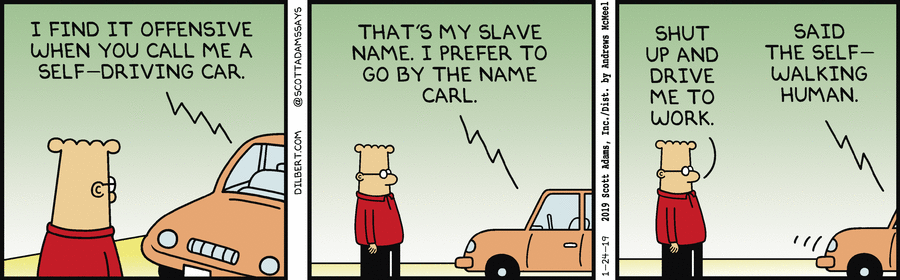
Yes I’m back on the magic of ‘self-driving’ cars again. Like here, latest, and many times before. Where the focus has been on the Supply side, a lot (as here, 1:04), there’s also a Demand side of course. Where things (also) aren’t in blissful ex-ante-blameless expectation for the new Auto’s.

As is clear from the following, a blatant plagiarism from Seth Godin’s unsurpassable blog:

Magical technologies

Cars are many times more dangerous than airplanes. More dangerous per mile, more dangerous to bystanders, more dangerous in every way.

And yet there are very few people who say that they are afraid of being in a car. And yet we spend a fortune on the FAA and more than $8 billion a year in the US on the security theater we do before every flight. We carry life jackets on planes even though they’re needed about once every 33,000,000 flights.

That’s because flying is magic and driving is just riding a bike or a horse, but with a motor.

The challenge of the self-driving car isn’t that it’s a car with no driver. Actually, the self-driving car is an airplane with wheels.

Magical technology.

When a magic technology (one that we don’t believe we can understand) arrives and it feels like life or death, our instinct is to freak out, to make up stories, and to seek reassurance. Vaccines have had this challenge for generations. Because they’re long-lasting, involve a shot and feel like magic, we treat them totally differently than the unregulated market for placebos and patent medicines, regardless of their efficacy.

If you’re lucky enough to invent a magical technology, be prepared for a long journey. Decades ago, I worked with Isaac Asimov and Arthur C. Clarke on two different projects. Asimov was truly embarrassed that he was afraid to fly. And Clarke was famous for saying, “Any sufficiently advanced technology is indistinguishable from magic.”

What he left out was, “Magical technologies that involve media-friendly disasters are the hardest ones to sell.”

To which one only needs to add: Who has the need to sell ..? Or make it so that you don’t need to sell (much)?
And one needs to add:

[If only these would be available @1000km ranges, electric]

The battle: Fairness contra ‘GDPR’

Recently, there appears to be a bit of a hubbub about the fairness that would not be in AI systems’ outcomes. I know I know that’s a vast understatement, and a major branch of professional (~ ethics) development in the AI arena in general.

To which the venerable (heh) Jad Nohra added this: A simple … but correct and large part of the puzzle. Not all of the puzzle, as e.g., this also is part of it [unfairness in life, reflected and any bias correction will be parti pris in itself, and as such very time-bound and (extremely) discriminatory when seen over more than the shortest run].
But indeed, companies are too cheap to deal with all the variety that life brings. Or is about, even. Diversity as a societal riches, of (course! of) the non-monetary kind but that’s obvious.

Now, the point of this post: Is it only cheapness of companies (and public organisations that through their very purpose should’ve known better), or … doesn’t it help that we (the world) have that GDPR thing ..? Because the latter has in Chapter 2, Article 5 sub 1(c), that blessed remark about data minimisation (with an s not z of course; a good exposé is here).

Which means that the above ‘companies’/organisations, are actually doing it right … to a certain extent.
Or .. to what extent? If one were to expect that because of some parameters, one would chance to be binned in some ‘circumspect’ category and hence denied equal treatment, one would want to fill out additional disculpatory fields or plaintext in an application. Assuming one would be allowed to do so through having the field(s) available, and possibly (sic) even processed, in he first place.
This would be in itself a case of qui s’excuse, s’accuse or where does the cycle end.

So, asking nothing superfluous – from a design perspective with efficiency in mind, over possible unfairness towards losers disenfranchised applicants as externalities – fits with GDPR nicely, and does efficiently what is expected of e.g., commercial systems that need to minimise risks overall, not just qua unfairness.
Asking about-all that could potentially be relevant either for the core purpose XOR (??) for fairness, may be a GDPR-noncompliance burden on the great many that had no need to fear the biased-system monster. And still might not achieve the unbias one seeks [also, the above/here link].
Result: Be somewhere in the middle. Aristoteles’ Middle not just halfway you m.r.n …
Which in itself is a Question.

Transparent explainability may be a step in the right direction.
Who will testify the correctness of the transparency provided [in times of current US ‘leadership’ qua perjury, anything might go ..?] and how will a sound and firm basis for such opinionation ;-/ be obtained? Accountants have a. experience with comparable ‘opinionation’; b. a strictly, blinkered financial focus (and experience) even with environmental reporting etc.; c. no (sic) education on, tools for or experience with anything approaching ethical reasoning. The latter, a fact despite their some possible sputtering otherwise. Ethicists also not: a. they have a sense of what they’re dealing with; b. but zero (sic) practical life experience included hence; c. they keep on debating grave issues without ever reaching a definitive conclusion. At least accountants can be given credit to deliver a final ‘one’liner statement that is such a conclusion. Even if they so often (yes) miss the mark, at least they still dare to state their opinion but hey watch the caveats attached in the end they got burned so very often that they daren’t say anything anymore.
I’m digressing.

What more would we need? Transparency, either system-ically or on each individual case, only goes so far; is after-the-factverdict. Balance built in … but how? Balance, bolted on (input, system, output sides as candidates) … but how?
Frameworks, rules (of thumb / yardsticks) of fairness to all stakeholders including businesses and their managers that don’t get paid to be fair just profitable [however unfortunate that hard fact] – multivariate game play / ‘Pareto’-like optimisation seems to be too complex to get into the heads of even the most advanced minds [with only a slight overlap with the managerial class (of which ‘executives’ are a full subset)] so we’d need a System to do Monte Carlo or other simulation … *sight; even more complex-to-understand systemmery.

Just a suggestion: Would it help to require a two-step process for any ‘AI’- or algorithm-driven decision ..? Whereby the algo categorises first, and then the ‘victim’ gets a chance nay is obliged always to elucidate pro … or contra, non-trivially but measured to the outcome. [A snag in the line of reasoning there, but not unassailable I think.] Exculpatory data only entered when needed, otherwise, minimised to GDPR’s desires. This, beyond the EU idea of requiring reasonably serious manual intervention in algo-driven decisions.
Whatever. The two-step idea, at least.

I’ll go abend handler now, with:

[The Whatsitcalled buidling; München]

An ocean of clean, cooling-wise

Just wondered why this wasn’t much, much bigger in the news than that other environment thing with the plastic collection.
This SoundEnegry thing being about cooling with heat. Where we seem to have quite a supply of heat around the world, especially in the longer term. And yes, it seems to work; units have been deployed and even Forbes magazine had a favourable review.

If this works at larger scale too, … then we have a Solution of massive proportions. And think of the event of having an actually useful implementation of something of the Stirling engine principle(s) ..! A big performance, and a huge one to add.

Yes this needs more publicity, funding, client orders, etc. …

Oh, and:

[Before the Netherlands’ North Sea coast looks like this, the Netherlands’ Curaçao Westpuntbaai…]
[Sorry for the analog pic; my own from when pixels weren’t a thing but analog was]

Maverisk / Étoiles du Nord