4th of July, a message from the US of A

On controls and their systemic ineffectiveness per se. As written about a lot in the past year on this site, PCAOB now finally seems to find out how things have been ever since SOx… in [simple block quote copy from this post by James R. (Jim) Peterson]:

The PCAOB Asks the Auditors an Unanswerable Question: Do Company Controls “Work”?

“Measure twice – cut once.”
— Quality control maxim of carpenters and woodworkers

If there can be a fifty-million-euro laughingstock, it must be Guillaume Pepy, the poor head of the SNCF, the French railway system, who was obliged on May 21, 2014, to fess up to the problem with its € 15 billion order for 1860 new trains—the discovery after their fabrication that the upgraded models were a few critical centimeters too wide to pass through many of the country’s train platforms.

Owing evidently to unchecked reliance on the width specifications for recent installations, rather than actual measurement of the thirteen hundred older and narrower platforms, the error is under contrite remediation through the nation-wide task of grinding down the old platform edges.

That would be the good news – the bad being that since the nasty and thankless fix is doubtless falling to the great cohort of under-utilized public workers who so burden the sickly French economy, correction of the SNCF’s buffoonish error will do nothing by way of new job creation to reduce the nation’s grinding rate of unemployment.

The whole fiasco raises the compelling question for performance quality evaluation and control – “How can you hope to improve, if you’re unable to tell whether you’re good or not?”

This very question is being reprised in Washington, where the American audit regulator, the Public Company Accounting Oversight Board, is grilling the auditors of large public companies over their obligations to assess the internal financial reporting controls of their audit clients.

As quoted on May 20 in a speech to Compliance Week 2014, PCAOB member Jay Hanson – while conceding that the audit firms have made progress in identifying and testing client controls — pressed a remaining issue: how well the auditors “assess whether the control operated at a level of precision that would detect a material misstatement…. Effectively, the question is ‘does the control work?’ That’s a tough question to answer.”

So framed, the question is more than “tough.” It is fundamentally unanswerable – presenting an existential problem and, unless revised, having potential for on-going regulatory mischief if enforced in those terms by the agency staff.

That’s because whether a control actually “works” or not can only be referable to the past, and cannot speak to future conditions that may well be different. That is, no matter how effectively fit for purpose any control may have appeared, over any length of time, any assertion about its future function is at best contingent: perhaps owing as much to luck as to design — simply not being designed for evolved future conditions — or perhaps not yet having incurred the systemic stresses that would defeat it.

Examples are both legion and unsettling:

  • The safety measures on the Titanic were thought to represent both the best of marine engineering and full compliance with all applicable regulations, right up to the iceberg encounter.
  • A recovering alcoholic or a dieter may be observably controlled, under disciplined compliance with the meeting schedule of AA or WeightWatchers – but the observation is always subject to a possible shock or temptation that would hurl him off the wagon, however long his ride.
  • The blithe users of the Value-At-Risk models, for the portfolios of collateralized sub-prime mortgage derivatives that fueled the financial spiral of 2007-2008, scorned the notion of dysfunctional controls – nowhere better displayed than by the feckless Chuck Prince of Citibank, who said in July 2007 that, “As long as the music is playing, you’ve got to get up and dance… We’re still dancing.”
  • Most recently, nothing in the intensity of the risk management oversight and reams of box-ticking at Bank of America proved satisfactory to prevent the capital requirement mis-calculation in April 2014 that inflicted a regulatory shortfall of $ 4 billion.

Hanson is in a position to continue his record of seeking improved thinking at the PCAOB — quite rightly calling out his own agency, for example, on the ambiguous and unhelpful nature of its definition of “audit failure.”

One challenge for Hanson and his PCAOB colleagues on the measurement of control effectiveness, then, would be the mis-leading temptation to rely on “input” measures to reach a conclusion on effectiveness:

  • To the contrary, claimed success in crime-fighting is not validated by the number of additional police officers deployed to the streets.
  • Nor is air travel safety appropriately measured by the number of passengers screened or pen-knives confiscated.
  • Neither will any number of auditor observations of past company performance support a conclusive determination that a given control system will be robust under future conditions.

So while Hanson credits the audit firms – “They’ve all made good progress in identifying the problem” — he goes too far with the chastisement that “closing the loop on it is something many firms are struggling with.”

Well they would struggle – because they’re not dealing with a “loop.” Instead it’s an endless road to an unknown future. Realistic re-calibration is in order of the extent to which the auditors can point the way.

And … there you go, for today’s sake:

DSCN7728
[Watching (us against) you …]

Wired / Tired / Expired, July 2014 edition

DSCN0704
[This one I do know ’cause I’m from Barça]

So, here’s the July edition of my Wired / Tired / Expired jargon watch overviews, a mixed bag and a shortie due to Summer:

WIRED TIRED EXPIRED
Developing IoT methodology, step by step Hyping IoT and wearables, not knowing the difference Hyping Big Data
As here. Just track this, this and this page. Do I really need to explain this ..?
Security breaches are normal APTs Privacy
We’re getting used to massive data leakage; don’t care too much anymore. Outrage ..? Not so much. Just mass abandonment. ’cause they’re so hard to tackle, people lose interest. But still they’re out there. In with you. Yeah, yeah. New EU regulations will mean massive changes. But only after they will arrive. Someday.
SBR/XBRL (still)
incl Continuous (extremely (ad hoc) sliced and/or granualar) Assurance
Services diversification Quarterly EBITDA
Finally, finally it begins to dawn; the breakthrough of ideas re this, as prof. Verkruijsse already knew. Will lead to fuzzy positioning, same price pitch, bland results. Really? Who would still be interested …? The geriatric demographic will no longer be interest(ed).
Business canvases (rapidly changing) No business plans, just an idea to pitch to VCs Business cases
Since the world changes so fast, and you should know where you come from and where you’re (thinking you’re) going even if the picture isn’t crystal clear and constantly changing. The odd side out; too vague, will not be acceptable. Show me one that isn’t a great big lie.
Suits Good Wife Matlock (reruns)
Witty, yet showing vulnerabilities and for once, somewhat subtle pointers to actual slightly vulnerable personalities. Has gone into repeat mode. Just stale, man.
Locally produced Superfoods Wheat grass
Nearshoring of your food supply; keeping the logistics to a minimum, and close to your environment. You did not miss the bombardment of debunking scientific articles on these, did you? Goes in with Birkenstocks (see below)
Vinho Verde Grüner Veltliner / Prosecco Rosé
Ah, how refreshing for the season! Brosecco, both. Austria tried but, see, it’s not (only) about the grape, it’s much much more also about Quality. Which always, always, ends up being way too sweet when ‘unfreezing’ to doable temperatures.
Havaianas / Juichpak (tie) Regular flipflops Birkenstocks
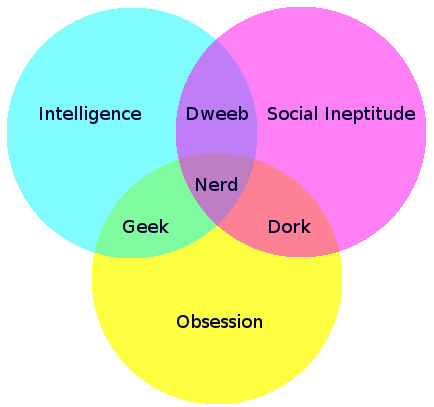
W now, but will be forgotten next month… Dork-style. Or top right of:
nerd-venn-diagram-9420-1252236207-2
Don’t forget the goat hair socks…

OK, any suggestions for next month’s edition ..?

Book by Quote: David, mostly plus some Goliath

In the series of Book by Quote’s, I was to enter the quotes from Malcolm Gladwell’s David and Goliath here.

But then, I have the Dutch version (was a gift). And, of all of it, I only would have three (3) quotes to share. Because, after the Introduction, it all became Boring so quickly that I found little to share…

But hey, for you there’s always:
20130326_131921[1]
[Wintery feelz, right ..?]

Then, for the ones among you who could hold out past the picture, here’s my take on the back-translation of the three quotes I found interesting…:

This is called the Principle of Legitimacy and legitimacy depends on three things. Firstly, those that are asked to bow to the authority, should have the feeling they have a voice and they are listened to when they speak up. Secondly, the rules must be predictable. There must be a serious expectation that the rules will be about the same tomorrow as they are today. And thirdly, the authority must be equitable and fair. One group shall not be treated different from another.

Hence, power should be seen as legitimate, or it will have an adverse effect.

Kennedy writes: The point with deterrence is that it’s about what it means for transgressors and potential transgressors. It is about how they see the rewards, risks and trade-offs.

And that’s it. Not even the main line of the books, that is repeated ad nauseam by returning to a select few examples ad nauseam. That are the select few well-known ones, because they are the exceptions, maybe …!?
Glad to have read the book, to have it off my list and to be able to validly claim to have read it (all), but let’s move on…

Iconic clarity failure (privacy edition)

Got a pointer to the icons that are in the EU Privacy directive.
Wow. I can’t even … (did I just write that ..!?)

See whether you’re able to guess the meaning of the following:
Icons

A big Nope, huh …? The answers, after the break… Continue reading “Iconic clarity failure (privacy edition)”

Live by the rules. Hopefully, not.

[Western version]

Hm, you wanted to live by the rules …? Hopefully, not in this way…

Next question would be: On what principles would you decide which rules to follow, and which not [so much] ..? Wouldn’t that constitute deeper and/or pre-existing moral/ethical principles? What and where’s the real instruction value ..?

But then, of course:
DSCN7427
[Relevant, MD]

OSSTMMPerimeter ..?

Just a note; was struck by the OSSTMM approach towards the structure of infrastructure. [Disclaimer] though I am quite a fan of the OSSTMM approach (and do want to write up tons of whitepapers linking it with my ideas for moving forward in the InfoSec field without having to revert to #ditchcyber bla), I feel there’s a snag in it:
The analysis part seems to still take a perimetered, though onion, approach. The Defense in Breath is there, for sure, but still the main (sic) focus is on the primary axis of the access path(s). Does this still work with the clouds out there and all, focused as they are on principalled agnostics on where your data and ‘systems’ might hang out?

OK yes now I will go study the OSSTMM materials in depth to see whether this is just my impression and I’m proven horribly wrong, or …

So i’ll leave you with:
DSCN3689
[Hardly a street, next to Yonge]

Maverisk / Étoiles du Nord