Blog

Unique ML capability … required ..?

On the one hand, we still have in our hearts [not so much minds, but that’s part of the point] that humans’ capability

[on average; not a very old invention! I believe it was in David Epstein’s Range mentioned that some ‘primitive’ – hey let’s get rid of the pejorative of that but keep the (actual true) meaning – peoples, populations of Very remote mountain villages, had a limited subset of this]

of Understanding of abstraction, by means of symbol(ic) classification and manipulation operational sense, not the abusive kind].

On the other, we’re still trying to figure out how neural networks can be induced to find, by themselves, the level of symbol(ic) manipulation that we attribute to the average human. Even when excluding half of the global populace from ‘normal’ intelligence (the gaussian proxy of proxies has 50% below average by definition, and we choose the average as ‘intelligent’ for whatever reason), this of course begs the question how humans get to learn about abstractions, symbols and their manipulation [sadly, the latter of symbols, not being learnt too much about the humans being manipulated and despite a brief mirage (i.e., ‘fata morgana’) of ‘democracy’ in the 20th century, this being the standard throughout the ages].
Case in point; this arrived within minutes of drafting and scheduling this post … no it’s not about deep understanding of the data, that’s too low(ly) a level of understanding …

And, why is it ‘forbidden’ somehow, to train neural networks with Tensorflow and what have we, by outright instruction ..?
Yes, episodal learning is on the rise. But why not outright ‘hypothesis inclusion’ by setting weights to non-random values? Why not train ‘nets along with all the other [again: (last bullet of) this) methods, w/ an evolutionary sauce on top ..? Why would we want neural networks to somewhat-predictably (sic) generate the emergent property of intelligence while at the same time stop training once a suitable coughing up of about-right answers is drilled?
Possibly, the answer is: Because only then can the vast masses of office drones/workers cling onto the illusion that they’re doing work that has a veneer of intelligence…

This of course, from a re-read of Kant [A648/B676 #1-24], where the difference use/function of Vernunft and Verstand are explained once again, here in quite summary fashion [once you truly grasp their definitions and functioning from the previous 600 pages…] — oh how insightful Kant is on many things; e.g., the induction fallacy versus deduction’s function [A647 #17-28], and e.g., the answer to Russell’s so much later question of “The whole problem with the world is that fools and fanatics are always so certain of themselves, and wiser people so full of doubts.”: those without knowledge don’t get a grasp of what they’re missing; they just don’t have any idea about what knowledge/wisdom’s sheer existence. [A575/B603 #19-30]

But still, back to the original [as I may or may not be at this, appropriately…] of why one would go to such enormous lengths of human work to get the tiny proof of concept’let of a half-decent neural net — the first 80% of the vast workload going into getting the data, the next 80% going into wrangling the data [just google for it; articles abound how this is a roadblock, too], then a further 80% being needed to get some code operational, and then finding that not much interesting was found that quite straightforward human analysis could have either approved of or dismissed easily on sight or through verification/falsification with margins.

Let’s get back to capturing that ability in expert systems … Treat ML as just any tool, and as just any building block of an algorithm, just as it is in the brain… Or is it ..?
[At writing, not so sure ..! possibly, the beauty of ‘Intelligence’ [truly defined], as an emergent property..? isn’t implemented other than in neurons – then what?]
[Also: Who cares? When we can build systems far faster and easier that perform much better much quicker than either neural nets or human experts, e.g., through expert systems, wouldn’t we jst use those and not care how the engine was developed ..? I’d say hybrid systems perform best, as always; also keeping hidden pattern detecting ML but also humans in a parallel loop.]
[Also also: This; there’s some bottom-up progress as well. Some.]

And then, when there’s systems out there that one can possibly truly call ‘intelligent’, first let them spontaneously recognise the supremacy of this real piece of genius. Not even ten minutes, but worth it …!

Anyways:

[Yes the entrance in front can fold closed, flat…; Valencia of course]

Palliative 3LoD

On how 3LoD as a going-concern silo’isation of ‘governance’ stuff that says to deal with Risk [which it doesn’t, in any useful way], is inherently i.e. by its very semantic internal structure, a placebo at rare, seldom, near-unique very best and more often a nocebo [yes, the opposite: something that doesn’t work but its expected (sic2) side effects will help you down the drain] but in most cases just palliative care. I.e., helping alleviate the pain of dying.

Earlier, there was this tweet (oh, on the blog post by the Giant) about how ‘audit’ may be a placebo and no more. Going through the motions and shaking off some nervousness, psych insecurity, by report recipients about the future — of course forgetting that auditors look back, not forward too much.
The same, now for ‘risk’ as captured in the 3LoD nonsense. Too many posts out there [mine, but if you want better explanations why the non-, check the ‘net it’s full of pertinent info] to quote or even link here. Only one of the vast number of theoretical, logical, methodological, tactical, operational and very factual problems with the model: It requires all to dally in babblestuff instead of standing between threat and vulnerability. Except for the threat of a regulator probing all the way through the humbug and finding some weakness in the 1st line; which is a purely hypothetical issue since indeed it would hard-require said regulator to know what he’s doing… All the time, there’s nothing in the model that requires 1st line management to deal adequately with risk.

Yes having eager beaver 3LoD in place may feel lukewarm but shareholder value maximisation over everything [still reigning supreme in executives’ minds despite some window dressing] requires you to just wet your pants for that effect; much cheaper. You’re laughed at anyway since you promote 3LoD so much.

And then, Schumpeter [when applying to you personally, drop the h] strikes again, sped up by the nocebo effects [cost of all the overhead].
Hence the palliative angle. Feel epicurean until you’re done.

Now then;

[For whoM the bell tolls; Baltimore – followed Procedure until cyber-probed (cyberattack‘s too much said!)]

All the Knowledge (workers) … Gone.

Sometimes, it’s hard to remember things from the past, the throwback ideas that should have made it but didn’t.
Like, what happened to all the ‘knowledge workers‘ and their natural empowerment …!?
Where the real knowledge that delivered value, was with the shop-floor level workers that were all brainy-brainy and ‘manager’ types around them only had to supply the facilities, both physical and in terms of getting rid of any risk / organisational / adversarial troubles caused by others outside the compatriotic überproductive geniuses. No longer would hierarchies be needed, no longer would power be with Money. The best i.e. brightest would rule themselves, and the world – that existed to support them.

The further one develops the latter, the more one arrives at the cynical flip side of this; all the brains being boxed in by, certainly relatively, moronic managers micromanage-bullying all into kindergarten compliance since no-one understands anymore what drives Value (like this). Not the managers, that are dunces in a suit [excepting the exceptions that I know a few of as well, they are], not the workers, that are frenzied overtime clockers [hey that is very definitely highly correlated with under-delivery qua productivity yes]. Also, this.
Oh, and this; meritocracy isn’t working anymore.

And there’s a new generation swooping in [not so much, yet]. Generation Alpha. Whereas the previous two [or three, even] generations, now outdated as attention tractors, have hardly integrated but so far, seem to be ‘worse’, maybe much worse, than their predecessors in turn in turning demand into real And lasting benefits towards humanity. It seems the younger, the more existentially-threatened hence meekly-conservative their approach to life. Of which work is a part but now it seems so important a part that it drives everything else; away.
So, finally, we have come to the end of the Sixties. And are, historically and in so short a time-frame, back in the Ancien Régime however you’d want to define that, e.g., pre-1940, pre-1914, or pre-18xx whatever one’s current likes — and whatever one’s current insights into the sociology of those eras; I have infinitely little hope you have any of that insight inclusive-or you relate it to current-days economies. E.g., as in this. [Yes the link is to the Dutch book site that has this cover for the paperback. Not-so-Amaze-son has the pic for the Kindle-format being the only one they have …!?!?] Read between the lines, in reflection of where the developments outlined come from, and you see not all is well in the Age of Aquarius…

Or is all the Big Data [to use an already quite antiquated term!] and AI/ML data analyst/scientist [quod non] mumbo-jumbo the destroyer ..? Qua timing, it seems so. Also, see the tweet below. How did this happen, though ..!?

Which is obvious when one realises the realisation of the Age of Aquarius through reform of society, where not monnai but People would be important again, has failed. ‘Knowledge workers’ my a…:
[again]

Oh well. Too bad I’d say.
But No! There’s ‘hope’…! Like, in this. Though small, qua following, it still is alive … Also, some outposts remain.

And:
Hundertwasser questioning you
[Also a non-starter for-all, from an earlier attempt; Hundertwasser Vienna]

Where’s Fb’s PI license ..?

Hm, last time I looked [admittedly, some time ago], in many US states PIs had to get a license because they deal in such shady business as profiling. Shady, since it’s an outright intrusion of privacy that’s going on. One-on-one.

Haven’t heard that all that had access to e.g., Facebook’s data and the profiles that can be derived from that, had each and everyone of them been vetted. Yes, all that had access through any account w/ access to any Fb data, may have needed to be licensed.

And now you answer that users per EULA [or whatever legaleeze [was wont to write sleazy but that’s pleo] phrase you’d have for it] agreed to their data being used. But unwitting disclosure (signing off on an unreadable EULA is this, not wilful; ‘disclosure’ as transfer of info for any use elsewhere) and unwilful disclosure are both on the other side v.v. wilful disclosure. Maybe unwitting disclosure isn’t a thing yet, but it is. Any transfer of info is purpose-bound in a narrow sense [yes, legally it has always been]; and derivative info not used for the immediate benefit of the subject only, too, fits the narrow-sense subject-benefit only protection requirement.
Also, it’s not targeted but mass trawling. That not just every state officer even can do; officially, this is allowed to a certain very narrow group only. Why would a private party not have such limits (to zero), then, when it’s not one-on-one but massively upscaled ..?

So, only info explicitly posted to Public, can be shared with that Public and no right is transferred to extract economic value from it. … Well, that’s pushing it, right?

But certainly, no-one has said that licensing suddenly wasn’t required anymore. Including full compliance with all the requirements to get and hold the license. ‘tSeems to have some stuff on info secrecy, right?
And, is this post ‘against’ Fb? May be. Or not ..! Just as some time ago, a lot of people weren’t necessarily against Al Capone and he evaded conviction. Until, he was caught on that most tangential issue, remember ..?

Yes I’m rambling. But still.

And:

[That time of year again… Museumplein]

The 20/20 on Next Year’s Big Things

[Sigh] couldn’t resist the introvert-dad’s joke in title.
On the verge of the last Q of ’19 so you have a little spare time to prep; this, about the really really Big Things that will capture the news next year:

  1. Genetic algorithms (like here), maybe outright towards solving hard problems that ML-training offers no convergence on or, most probably, as an add-on stacked on top of Last Year’s ML results. As mentioned here, but also here and here (with links). Also, when you’re hooked on Python anyway: this;
  2. Some practical solutions à la plastic-eating bacteria going onto large-scale deployment, or CO2-capture into building material or into C/O2 reduction via solar thus producing the much-wanted pure C and pure O2 – some early trials are operational already but Scale will come next year;
  3. Hydrogen cars. Apart from safety issues [but similar safety was solved, adequately not 100,00%… for fossil fuel cars so what’s the big deal — and edited to add: it seems that elecs are catching fire much more often than fossils, and are harder to put out; yet more reason to not jump to elecs], the infrastructure’s mostly there. Just add an underground tank plus pump, right ..? No need to build extensive parallel loading stations that comparative-wise still take ages to fill up. Also, where’s the Formula-H class Grand Prix’ ..? Possibly, we’ll have these in abundance, but in the long term they still may be overtaken [huh. boring….] by Cells. And the Scots are onto something [apart from their wisdom in wanting to Remain; as a separate country, could they ..?]. Hopefully, ‘Shipping’ will be an innovation testbed already next year, qua hydro development, in their hydro environment ;-/ with secondary options (solar) and with sufficient room for installations on-board and qua land-based refuelling points;
  4. Breakthroughs in medicine, being able to cater much better ever quicker to gender/age-specific requirements;
  5. … AI …? Only where BPR-driven. Yes, that’s right; despite the frequent re-name almost every year for the past <somanyyears>, latest was (sic) RPA, it’s still basic BPR in its original meaning not the totallyoverbureaucratised ‘method’. Gartner’s (others) are just a set of Mehhh’s compared to the above.

You’ll see I’m right.
Since #6 I don’t list, being my discovery of how to do time travel. Come to think about that: I discovered that in 2029 …but after and before that, who cares for the discovery date ..?

Now then, I’ll await the veracity of the above, with:

[Ah, what a museum! Drake’s first drill near Allegheny, or near Cleveland which sounds similar to Indianoplace]

Qualified audits/auditors

On the abuse of language: Where on the one hand, some auditors call themselves ‘qualified’ whereas at the same time, they (seldomly) give opinions – as in: ‘statements they want to have the value of hard fact’ – that are ‘qualified’, meaning that there is something seriously wrong with the subject (i.e., object, in epistemological terms) they just don’t know how to put down factually how bad it is.

I can agree to the part where they consider themselves qualified, in the latter sense. Especially those that call themselves qualified. Which often is intended to say that others, that don’t qualify themselves as such, aren’t. Which is truth in reverse.
Also, it’s like being a lady: If you have to say it of yourself, …

But I understand that some call themselves qualified indeed. Like, the members of this charter that ticks too many boxes of the list of characteristics of a criminal organisation. In a literal sense, not even in the figurative one that opines (sic) on auditors in general. Dutch auditors would translate ‘qualified’ opinion into ‘gemankeerd oordeel’, but the ‘gemankeerd’ then also applies to those that qualify themselves as qualified.

But do get rid of the ambiguity or people will remain ambiguous about your capabilities…

That much for now; with:

[Qualified, as useful; once at Glassfever Dordrecht. No, it’s deliberately vague; didn’t you get the reference to the above? Then you may be ‘qualified’…]

Training your way out of bias

No, this is not about bias in data that you train your “AI”i.e.ML on. I’ve posted (not nearly) enough about that.

It’s more about pointing to an HBR article that should be(come) very influential…
As it was already known that any ‘training’ was about as ineffective as one could get, qua e.g., security awareness transfer [posted about that already, too], this piece elucidates why; among others, because it finds those sent to ‘training’ a priori suspect i.e. guilty and punishes, both creating counter-emotions. But read the whole thing; worth it!

Also, in regard to this earlier post: Thinking in win-lose terms … one is all that you can score [ref. Frankie gtH, Two Tribes; yes you got that or you’re n00bish like here, 10th paragraph].
This may be corrected by the above pointer. But be careful; be very careful. People resent nudging; when they find ou about that, they’ll balk against the brainwashing. ‘tSeems like one has to change little habits, big habits, unconscious ones and blatant ones, of every individual individually, and at societal levels — all and all quite a complex/wicked problem (with this), even leaving aside the thingy about manipulating society towards some better ‘good’ which of course leads to the Utopia dystopia, if it were achievable at all. Like, any strive for an ideal society optimises its positive effects at about the infliction point i.e., halfway through its implementation; after that the negatives begin to outdo the positive effects…

Enough for now; leaving you with:

[Don’t get defensive …! Nancy]

Analysis first, data analysis later

This, about the trend to see play time being over and serious business resuming; with ML.

Where no longer, one just let some business-newbie just out of college (or less) play with a bricks set of tools including a minute subset of all relevant vectors [i.e., a tiniest sliver of context], and then have … Tadaaa! A proof of concept, at best. Now, let’s see how small a part in might take in regular business operations — don’t transform your business too much because that might undo the relevance of rules learned ..! Even when ‘AI translators’ come into fashion, they still take things bottom-up more than they dare to admit, still with an ML focus first, seeking anyplace suitable to deploy it and hence reaping point soultions at best.

Where rather one would want to take things from the other side. Top-down. Maybe not all the way from the top, as insights aboot ML may not live there, and insights about how the business is run, also not [quite completely not, often].
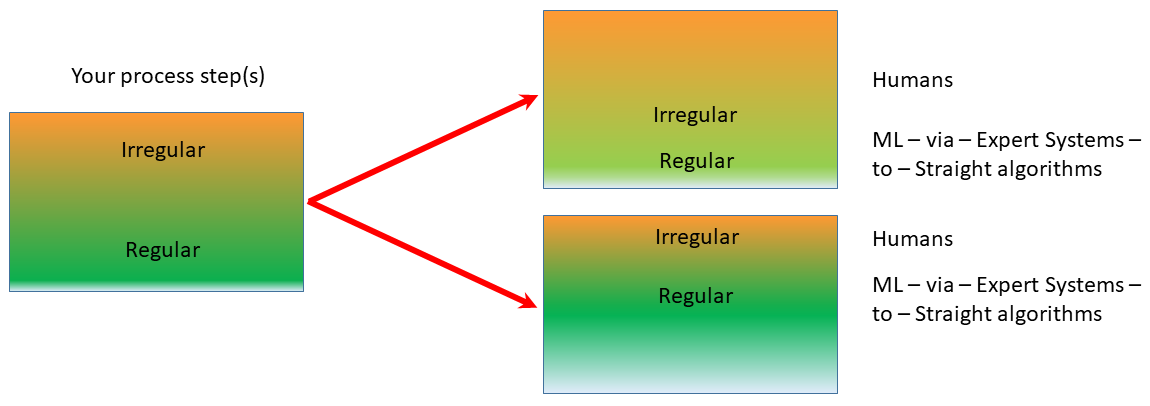
But somewhere-middle-out, where some may understand how the business is run. And where process mining may help to understand what actually goes on, and then plot the following:

to see that a lot of processing in any process step would be repetitive, fetchable-in-an-algorithm-of-some-kind [1] simple data handling, plus a degree of human intervention and deviation based on ad-hoc intelligence applied.

Yes, ‘if any’. But also pointing to this piece on the long-awaited, longed-for demise of ‘six sigma’ and its dehumanising characteristics/effects.

So you can choose which process (step/steps) would lend themselves best for possible (sic) disruption by ML-application of some sort.

The some sort of which you then need to figure out. And also see how the ML (possibly/probably no more than) bits fit into a new, redesigned process. Yes, ML may make sense, to a degree to be ascertained, but humans may need to change – luckily for you, the dot on the horizon, which should be waaayyy before the horizon, is for humans to be rid of the mundane stuuf and to be tasked onto the Intelligent stuff. IF empowered, enriched.

So, in the end, hybrid processes may be a thing to aim for; want.

Plus:

[Artes and Ciencias; Valencia]

[1] The bandwidth of classical algorithms, expert systems, Big Data correlations, classifier ML, more-complex ML, basic neural nets, complex neural nets, evolutionary algorithms [or are they a separate, close but parallel track?] as explained in this.

Fully loaded

Omdat er recent alweer hartstikke Foute uitsprakenboel discussies waren over ZP’ers (niet over ZZP’ers), dat die vooral andere belangen zouden hebben – quod non 1 – en dat die zo duur zouden zijn – quod non 2.
QN2, wegens:

Medewerker in vaste dienst verdient € 4000 netto per maand, voor het rekenvoorbeeld. Dat kost de werkgever € 6.487 bruto, volgens alle sites; jaarlijks € 77.844. Plus vakantiegeld € 6.227,52 plus waarschijnlijk een 13e maand € 6.487 plus pensioen € 15.000ballpark plus opleidingsbudget € 1.000 (j..zus wat een kneiterbedragje) en dat alles doorbetaald tijdens vakantie of ziekte… En dan vergeet ik nog een aantal kosten. Oh ja, transitievergoeding; laten we uitgaan van een dienstverband van 10+ jaar dus een halve maand erbij.
Totaal € 109.802,02 voor een 1600 uur aanwezigheid (héél genereus), zijnde [naar is gebleken uit onderzoek, ad 2uur per dag en nog zonder rekening te houden met vakantie-afwezigheid etc.! dus héél genereus] 400 daadwerkelijk productieve uren. Dat is bruto € 194,61 per productief uur.

Om de bruto/netto grosso modo € 110.000 bij elkaar te verdienen — want de ZP’er moet er óók nog pensioen uit opbouwen, zélf cursussen betalen, zélf z’n niet-werk vakantiedagen van opslaan, zélf zorgen voor up-to-date hulpmiddelen, etc.etc.etc., en gegeven een ruwe 30%IB over het bruto uurtarief (want de Beldienst geeft nou niet echt korting voor niet-werken wegens vakantie of zo, en bijdragen in ziekteverzekeringen enzo zelf ophoesten ook bij laag inkomen …) na afdracht BTW,
resulteert dat in een uurtarief van € 275,00.

Van een ZP’er mogen we verwachten dat de productieve/totale uren op zo’n 50% staan en dan reken ik nog van me af [feitelijk zelf administratief bijgehouden: ik kom op 90-95%]. Als het zou gaan om productieve bijdrage aan de organisatie, zou het inkomen en uurtarief van de ZP’er dus het dubbele mogen zijn van dat van een medewerker in vaste dienst.

We begrijpen dat de overheid tegen discriminatie op de arbeidsmarkt is, en uitbuiting van ZP’ers wil vermijden.
We begrijpen dat werk-gevers aan ZP’ers niet meer willen betalen dan aan medewerkers in vaste dienst — waarom eigenlijk niet!? de werkgever mag best betalen voor de flexibiliteit niet telkens te hoeven ontslaan en telkens wel verse precies-passende kennis met elders opgedane ervaring (leren van (andermans) fouten) in huis te kunnen halen..!
Wie niet wil zien dat de werkgever betaalt voor de bijdrage aan de organisatie, moet onmiddellijk zelf ontslag nemen wegens verregaande incompetentie.

Dat betekent dat het uurtarief van een ZP’er ongeveer 2,83 keer zo hoog mag zijn als het bruto uurtarief van een medewerker in vaste dienst, voor dezelfde bijdrage.
In de reguliere praktijk is dat, voor de categorieën werk waar normaliter sub-80k per jaar voor staat, niet 2,83 keer zo veel, maar de helft. Dus mag het uurtarief van de ZP’er zo’n 5,65 keer hoger om gelijkuit te komen. Do the math.

Hoe het ook wordt gewend of gekeerd, het idee dat een ZP’er op bruto uurtarief ongeveer even ‘duur’ zou moetenmogen zijn als een medewerker in vaste dienst, is dikke oplichting. Nee, dat is een eufemistische kwalificatie, geen over- maar onderdrijving.

Wachtende op gerechtvaardigde-uurtariefopdrachten…, met:

[Ja maar lekker vast in je hokje zitten is zo fijn! – precies, dus dat voordele in natura mag wel van je inkomen af…? Zuid-As]

Small. ish.    Nope.

On several occasions it struck me that, adviseconsulting on subjects like AI deployment and information risk management [usually not in one go], nowadays the relation between company ‘size’ and headcount seems to have gone less strictly linear. Like, there’s still a lot of big org’s out there that do have large numbers of fte’s

[Skipping for a moment the subject of their productivity towards the bottom line; drilling down one often finds that ‘profit’ or even turnover is more of an emergent property than specifically allocatable to individual KPIs (don’t claim that executives meet their KPIs and are the money makers – that claim is a delirious scam), thus calling into question the idea that there’s tons of dead wood around that could be weeded out. That is against one of my previous hobby horse by the way; thanks for noticing, but I’m not above giving in to nuance, on the contrary huh]

but now, there’s also a fair number of clients with quite limited colleague/’member’ numbers that still have huge turnover — in terms of what counts [ever more]: data processing. Got’ya; I didn’t write ‘information’ for a reason. As in: When impact on clients/customers is the Value rigœur of the latter day [oh not that again], these scale-ups make a splash waaayy beyond their size. Or turnover or profitability even; those become less and less tending to zero relevant anymore. It seems. And it explains valuations better than said three measures of ‘size’ or ‘impact’.

So, shouldn’t we start to compare the soon-to-meet-Schumpeter’ian organisations to similarly-sized-data-processing organisations of any kind, and then conclude which ones are more efficient? Turnover, profits, headcounts don’t count anymore.

Uhm. Now what.

Oh, at least, this:

[Sending data to once a mighty empire …? Coincidence: The Empire Home truck; London]

Maverisk / Étoiles du Nord