Blog

Plusquote, again

Well yes, another episode in the Plusquote saga:

Now you’re accusing me of optimism”

Which works well in these times of stale bureaucracies; is sought after for disruptive value and renewal. And, in general, is something one might aim for, in a way of Summer motto — weather be nice, weather be rain spells, one can attach a positive edge, mode, conclusion.

Also, for the latter:

[Unedited phone pic; giving light in a Larking building style (not -referenced!) atrium; Gemeentemuseum Den Haag]

Two EV extras

Whether it would be @ElonMusk himself or @BoredElonMusk or any of you to pick these up… Just putting them out (t)here, for your consideration:

First; there ‘was’ this CVT thing, back in the 80s/90s or so, that didn’t really take off the way it might have.
In particular, since it sounded so ridiculous when revving up/down beyond ‘normal’. Now, with much improved electronic/near-AI engine/car control (and travel/congestion forward-looking (AI) car/engine management), wouldn’t it be possible to apply CVT in a more sensible way, leading to (much) extended range on EVs ..?
We’re thinking small cars first, since the fully-automatic gearbox thing will still not pick up with aficionados except the few that keep silent and cannot stand the discomfort of switching gears in the traffic jams they’re invariably caught in — I mean, thus disclosing themselves as pitiful mediocre-management ‘staff’. But then, with smaller cars and such ‘fuel’ savings, smaller batteries may suffice hence making the total package viable..?

Second; I just learned that Teslas and other EVs are lousy caravan pullers ’cause, though the torque might make them perfectly suited, the acceleration slurps (huh?) the batteries empty way too quickly, leading to much insufficient range. When the caravaners hook up their cabins in particular for day-long travel…
Yes, this may not be a Tesla thing per se, as caravaners and T owners/drivers may be near-completely disjunct groups, but it goes for other, less-suspiciously electric vehicles as well. And caravanning may not be a big thing (anymore!) over in the USofA but still very much is, over here in Europe [disclaimer: I’m most certainly not into it].
Also, T is ‘rumoured’ to have this battery pack thing going on ..? So I wondered what the merits would be of building such packs in a way that they could be fit onto caravans, e.g., onto the adze’s (is that the right word …!?) that have some standardization, or make them easy-fits onto the most common caravan brands, and then either feed straight into the EV or be used as replenishments at stops/stop-overs. Or, just for caravan e-juice during stays anywhere e.g. at ‘campings’…?

Well, no thirds here. Whatever’itis breaking out. Plus:
DSC_0460
[When garages were meant to be beautiful; Porto — oh wait they still can be]

There’s Waldo for you; just some

Slightly annotated, and not aiming for completeness, as many worthwhile (sometimes quasi- or semiQuined!) quotes of Ralph Waldo E. have been posted elsewhere; this just my picks because of their profundity. And personal liking…

A cripple in the right way will beat a racer in the wrong; … Vinegar is the son of wine; … Long-lived trees make roots first; …
Yes indeed, when ‘managers’ may be in either, both, or (vast majority) neither situation …
And, one close to heart but one to remember in many a circumstance, like waiting for vindication of one’s insights.
Fast re-pivot, anyone ..?

The same good office is performed by Property and its filial systems of debt and credit. Debt; grinding debt, whose iron face the widow, the orphan, and the sons of genius fear and hate; — debt, which consumes so much time, which so cripples and disheartens a great spirit with cares that seem so base, is a preceptor whose lessons cannot be foregone, and it is needed most by those who suffer from it most.
Clearly, this a summary and precursor to Graeber and, moreover, Piketty.
Moreover, property, which has been well compared with snow, — “if it fall level to-day, it will be blown into drifts to-morrow,” …
Similar, in particular with regard to the latter mentioned author…

Words are finite organs of the infinite mind.
Indeed; I’ve repeated over and over that short sentences not clarity make — or if, then to the simpleton mind.

“The things that are seen, are temporal; the things that are unseen, are eternal.”
Contra the not-giving one-percenters of course.

Empirical science is apt to cloud the sight, and by the very knowledge of functions and processes to bereave the student of the manly contemplation of the whole. The savant becomes unpoetic.
Indeed, the (induction-oriented) Big Data analysts will succumb to dumb conclusions. The manly (note that of course rigour and courage; Aristotelian Virtue is meant here!) contemplation, the deductive parts of True science, should lead naturally.
And the savant… is there a better label for Big Data analysts on average? Note that indeed, some may be on the upper side of the average (as these go), but may be few and far off.

But the old oracle said, “All things have two handles: beware of the wrong one.”
Yes, true even when the thing is bonus incentives. Beware of bankers’ (et al !!) grip on those. But then, this saying may be applied against all of your un-agreeing fellow meeting members.

But genius looks forward: the eyes of the man are set in his forehead, not in his hindhead: man hopes: genius creates.
I couldn’t agree more; that has delivered all the posts you have read (all) on this blog for sure. And again, this is against ‘data scientists’ that only do ‘evidence based’ decision-making: There is nothing more hindheadedness than that. Shove the results in the hind section where the respective feel happy about that.

Only so much do I know, as I have lived.
One that stands out. In The American Scholar but in general, too. Fitting with the whoso shall be a man, shall be a nonconformist elsewhere [Frank Lloyd Wright’s motto — somewhat by necessity one suspects] but Truest of True. A call to arms of the Virtuous (as above).

The man on whom the soul descends, through whom the soul speaks, alone can teach. Courage, piety, love, wisdom, can teach; and every man can open his door to the angels, and they shall bring him the gift of tongues. But the man who aims to speaks as books enable, as synods use, as the fashion guides, and as interest commands, babbles. Let him hush.
One thinks here of the popular among the ‘visionaries’ [e.g., the Dutch Yuri’s calling out bits, no more, of what fashion guides, in a manner that ‘babble’ is positive] that might be capable of delivering or discussing things on smaller-G’s hype cycles but have no hope to ever achieve anything more than upfront vagaries and Calimero’s claims to hindsight correctness.

Whenever the pulpit is usurped by a formalist, then is the worshipped defrauded and disconsolate.
Just fill in the flavour-of-the-day politician(s) for ‘formalist’ as that is about the same thing these days, and you’ll see it’s true.

The vision of genius comes by renouncing the too officious activity of the understanding, and giving leave and ample privilege to te spontaneous sentiment. … Men grind and grind in the mill of a truism, and nothing comes out but what was put in. But the moment they desert the tradition for a spontaneous thought, then poetry, wit, hope, virtue, learning, anecdote, all flock to their aid.
I would agree. In full, quite. Think the PhD thesis with at least three footnote literature references for every ‘the’, ‘it’ and ‘possibly’ etc. My reason not to pursue a PhD..!

The vulgar call good fortune that which really is produced by the calculations of genius. But Napoleon, thus faithful to facts, had also his crowning merit, that whilst he believed in numbers and weight, and omitted no part of prudence, he believed also in the freedom and quite incalculable force of the soul. A man of infinite caution, he neglected never the least particular of preparation, of patient adaptation; yet nevertheless he had a sublime confidence, as in his all, in the sallies of the courage, and the faith in his destiny, which, at the right moment, repaired all losses, and demolished cavalry, infantry, king, and kaisar, as with irresistible thunderbolts.
I am said to have enjoyed good fortune on occasion. But lean more to the second part; though not a fan of said ’emperor’, one would be hard-pressed to not agree with his dictae (as supported by the true sayings of, e.g., Von Moltke the Elder.

Where there is no vision, the people perish.
Which could be a factual quote just like that. But could also be, the need for a lead. A Leader. How dangerous …

… the luck of one is the hope of thousands, and the bribe acts like the neighborhood of a gold mine to impoverish the farm, the school, the church, the house, and the very body and feature of man.
Thus, the 1%-ers lead the underprivileged masses astray at the hand of demagogues. ’nuff said.

… against that frequent misfortune of men of genius, — the taste for luxury. This is the tragedy of genius; — attempting to drive along the ecliptic [as a Prometheus with the Sun ..? ed.] with one horse of the heavens and one horse of the earth, there is only discord and ruin and downfall of chariot and charioteer.
A sure warning for the ‘visionaries’ … Their mortgage doesn’t get paid by being Right. Mortal life is unescapable.

Why needs any man be rich? Why must he have horses, fine garments, handsome apartments [obviously, for one’s mistresses! ed.], access to public houses and places of amusement [one things La Grange; ed.]? Only for want of thought.
Oh how this reflects on the previous, and on the 1%-ers…

Those who are urging with most ardor what are called the greatest benefits to mankind, are narrow, self-pleasing, conceited men, and affect us like the insane do. They bite us, and we run mad also.
What a concise, and very precise, description of regulator, supervisors, oversight boards, et al..!

We do not want actions, but men; not a chemical drop of water, but rain; the spirit that sheds and showers actions, countless, endless actions. … The world leaves no track in space, and the greatest action of man no mark in the vast idea.
So, one should not aim for achievement recognition — as that would undo its very attempt. As so often observed.

The two parties which divide the state, the party of Conservatism and the party of Innovation, are very old, and have disputed the possession of the world ever since it was made.
True, everywhere even when there appear to be more than two parties. Appear, cosmetically.

For as you cannot jump from the ground without using the resistance of the ground, nor put out the boat on sea without shoving from the shore, nor attain liberty without rejecting obligation, so you are under the necessity of using the Actual order of things, in order to disuse it; …
Interesting; “I don’t want to go into politics because you get caught up, will learn to howl” but the only way to change politics is .. to join it. By the way; R. Waldo E. follows on with a discourse on how every progressive turns into a conservative; much worth a study as it paint the picture so inescapably. Even when my ‘soul’ would resist…

Conservatism … always mitigations, never remedies; pardons for sins, funeral honors, — never self-help, renovation, and virtue.
The kick is in the tail…
… a timid cobbler and patcher, it degrades whatever it touches.
Just true, and adding to the insult.

But if I allow myself in dereliction and become idle and dissolute, I quickly come to love the protection of a strong law, because I feel no title in myself to my advantage. To the intemperate and covetous person no love flows; to him mankind would pay no rent, no dividend, if force were once relaxed; nay, if they could give their verdict, they would say that his self-indulgence and oppression deserved punishment from society, and not that rich board and lodging he now enjoys. The law acts then as a screen of his unworthiness, and makes him worse the longer it protects him.
At once, one sees the French revolution brewing. At seconds, one considers modern-day politics…

With this passion for what is great and extraordinary, it cannot be wondered at that they are repelled by the vulgarity and frivolity in people.
Which is why I feel counterforces sometimes / often, against my Good Intent. Right?

Unless the action is necessary, unless it is adequate, I do not wish to perform it.
My motto entirely against Bureaucrats…!
I do not love routine. Once possessed of the principle, it is equally easy to make four or forty thousand applications of it. A great man will be content to have indicated in any the slightest manner his perception of the reigning Idea of his time, and will leave to those who like it the multiplication of examples.
Again, I concur. Fully. Hence, my visionary work does not fall under the header of the abovementioned bumblers. And now for the last one:

… but it has good healthful qualities in spite of them; not least among which a healthy disgust of Cant, and an aptitude to detect her in all the million varieties of her everlasting wardrobre.
Needs no comment I guess. Plus:

DSC_0509
[Marker for the End of life reason; Foz]

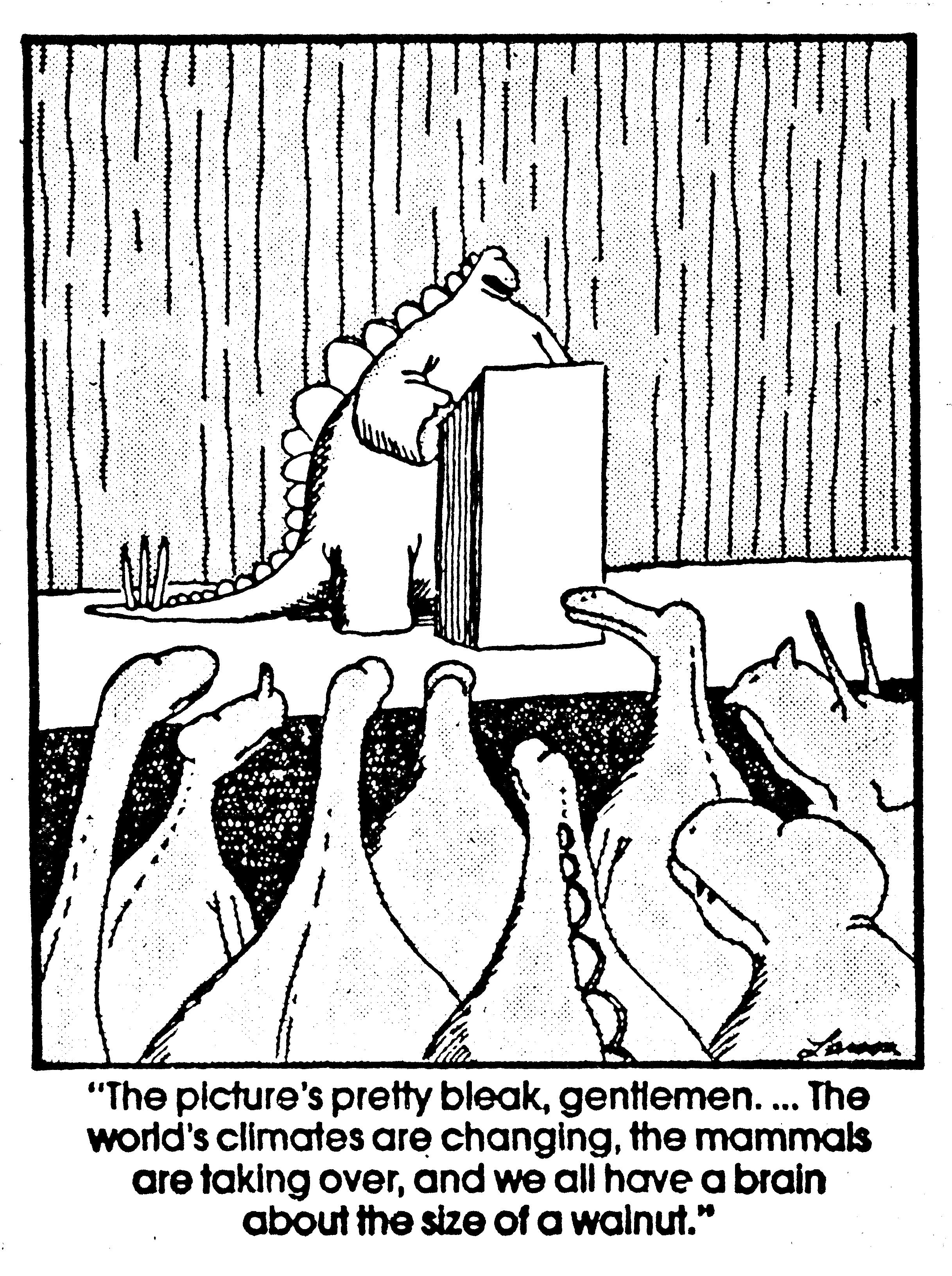
Walnuts, brain size and you

Combining some recent news, some really old news, and your place in between. Or not.

The recent news: Birds might have tiny brains, but they still may be very intelligent (as animals go). Now, on a related note, discoveries show that the brain cells of birds may be smaller and/or much denser packed than they are in, e.g., humans and family.
The really before-stone-age news:dinosaurs-picture-is-bleak

Combined: Birds have a separate line of descendance from their dinosaur-time quite-close equivalents. Having survived some dino extinction rounds and still remain quite similar in body and operations as before, having kept the same lightweight and small-package brain structure too?
Then, maybe the dinosaurs weren’t so stupid either with their small but possibly also very densely packed neurons and they just had a bad hair day (that’s what you get when a comet strikes your coiffure — footballers beware).
Just a, very,very,very after-the-facts hypothesis… And:
DSC_0595
[For wine making; isn’t that obvious !?!?!? Quinta do Vallado; Douro]

The Learning-from-error Error

[Thread development; under ~ ]

Tell me, did you go to school somewhere? Did you finish it, and/or completed assignments and exams to somewhat satisfactory degrees?

Congratulations… To the ‘common’ wisdom that one only learns from error, you have failed. In life.

Because, according to too many, fail fast fail often is the best way to gain knowledge about what doesn’t work — automatically leading to the assurance that doing things differently, will work. If you tried and the result didn’t fail, you haven’t learned. So, if you just learned what centuries of the most learned men (plus women…) brought to you, and achieved, acquired any compound body of knowledge, you may have knowledge but are useless otherwise, like an encyclopedia without a reader? Like some millennial that can google anything but doesn’t know (sic) how to apply the search results (let alone qualify them in the tremendous bias that’s in there)? Or did you learn about process and application along the way …?

Thus, all that human culture is; transferred knowledge on facts, process and application, is denied. Where even Neanderthals had culture and knew how to learn from what had — positively — shown to work in practice (i.e., application, intelligence), you the fail-oriented stumbler, don’t reach up to their level of survivability.

Which leads to both this and this, with a large dose of this. ‘Traditional’ learning, and building enterprises that can last for centuries (or, until the wisdom is lost due to ‘CEOs’ and ‘managers’ quae non), as an antidote and sensible path.

Now, if you can just leave us sanes, the rest of the world to actually be successful in the long and short runs …? Plus:
DSC_0497
[Just two boats, or an Atlantic Ocean of knowledge ..? Off Foz]

AId

To start, an introduction — how unusual:

René Descartes walks into a bar and sits down for dinner. The waiter comes over and asks if he’d like an appetizer.
“No thank you,” says Descartes, “I’d just like to order dinner.”
“Would you like to hear our daily specials?” asks the waiter.
“No.” says Descartes, getting impatient.
“Would you like a drink before dinner?” the waiter asks.
Descartes is insulted, since he’s a teetotaler. “I think not!” he says indignantly, and POOF! he disappears.

As recalled by YouByNowKnowWho from David Chalmers.

Which demonstrates quite a bit about identity, and artificial intelligence.

The identity part: To quote YBNKW, “… that identity is preserved through continuity of the pattern of information that makes us. Continuity allows for continual change, so whereas I am somewhat different than I was yesterday, I nonetheless have the same identity.” — thus, thinking (both the directed, problem solving way and the massively concurrent undirected, associative and ‘unconscious’ way) is what both constitutes and preserves Identity.

The AI part: Being the part where ‘intelligence’ or the I to the A (or human ~, whatever; after Ray you may not care about a hypothetical difference) is the thinking (or not) of René.

So, whether A or not, the I makes the Id. Not the Es in a mother’s darling child sense! there, it is the (‘super’?)ego but that’s another story.

Now, how to translate that to latest developments in the IAM, blockchain-trust, and ANI/ASI arenas ..? Plus:
DSC_0543
[Nuclear shelter, a.k.a. know your building history; Casa da Musica Porto but you surely knew that]

Another Q

Yet another, relatively (sic) random, quote with a kicker in the tail:

In support of this distinction, Chalmers introduces a thought experiment involving what he calls zombies. A zombie is an entity that acts just like a person but simply does not have subjective experience — that is, a zombie is not conscious. Chalmers argues that since we can conceive of zombies, they are at least logically possible. If you were at a cocktail party and there were both “normal” humans and zombies, how would you tell the difference? Perhaps this sounds like a cocktail party you have attended.

Again, from Ray Kurtzweil’s How to Create a Mind (p.202).
And, of course:
DSC_0018
[Just like that; Aachen]

Not just Q, IQ

Well, yesterday’s post was about just a quote, this one’s about what should be a full cross-post but hey, I’m no wizard I’ll just blockquote it from here because it’s so good (again, qua author):

Society in the Loop Artificial Intelligence

Jun 23, 2016 – 20:37 UTC

Iyad Rahwan was the first person I heard use the term society-in-the-loop machine learning. He was describing his work which was just published in Science, on polling the public through an online test to find out how they felt about various decisions people would want a self-driving car to make – a modern version of what philosophers call “The Trolley Problem.” The idea was that by understanding the priorities and values of the public, we could train machines to behave in ways that the society would consider ethical. We might also make a system to allow people to interact with the Artificial Intelligence (AI) and test the ethics by asking questions or watching it behave.

Society-in-the-loop is a scaled up version of human-in-the-loop machine learning – something that Karthik Dinakar at the Media Lab has been working on and is emerging as an important part of AI research.

Typically, machines are “trained” by AI engineers using huge amounts of data. The engineers tweak what data is used, how it’s weighted, the type of learning algorithm used and a variety of parameters to try to create a model that is accurate and efficient and making the right decisions and providing accurate insights. One of the problems is that because AI, or more specifically, machine learning is still very difficult to do, the people who are training the machines are usually not domain experts. The training is done by machine learning experts and the completed model after the machine is trained is often tested by experts. A significant problem is that any biases or errors in the data will create models that reflect those biases and errors. An example of this would be data from regions that allow stop and frisk – obviously targeted communities will appear to have more crime.

Human-in-the-loop machine learning is work that is trying to create systems to either allow domain experts to do the training or at least be involved in the training by creating machines that learn through interactions with experts. At the heart of human-in-the-loop computation is the idea of building models not just from data, but also from the human perspective of the data. Karthik calls this process ‘lensing’, of extracting the human perspective or lens of a domain expert and fit it to algorithms that learn from both the data and the extracted lens, all during training time. We believe this has implications for making tools for probabilistic programming and for the democratization of machine learning.

At a recent meeting with philosophers, clergy and AI and technology experts, we discussed the possibility of machines taking over the job of judges. We have evidence that machines can make very accurate assessments of things that involve data and it’s quite reasonable to assume that decisions that judges make such as bail amounts or parole could be done much more accurately by machines than by humans. In addition, there is research that shows expert humans are not very good set setting bail or granting parole appropriately. Whether you get a hearing by the parole board before or after their lunch has a significant effect on the outcome, for instance.

In the discussion, some of us proposed the idea of replacing judges for certain kinds of decisions, bail and parole as examples, with machines. The philosopher and several clergy explained that while it might feel right from a utilitarian perspective, that for society, it was important that the judges were human – it was even more important than getting the “correct” answer. Putting aside the argument about whether we should be solving for utility or not, having the buy-in of the public would be important for the acceptance of any machine learning system and it would be essential to address this perspective.

There are two ways that we could address this concern. One way would be to put a “human in the loop” and use machines to assist or extend the capacity of the human judges. It is possible that this would work. On the other hand, experiences in several other fields such as medicine or flying airplanes have shown evidence that humans may overrule machines with the wrong decision enough that it would make sense to prevent humans from overruling machines in some cases. It’s also possible that a human would become complacent or conditioned to trust the results and just let the machine run the system.

The second way would be for the machine to be trained by the public – society in the loop – in a way that the people felt that that the machine reliability represented fairly their, mostly likely, diverse set of values. This isn’t unprecedented – in many ways, the ideal government would be one where the people felt sufficiently informed and engaged that they would allow the government to exercise power and believe that it represented them and that they were also ultimately responsible for the actions of the government. Maybe there is way to design a machine that could garner the support and the proxy of the public by being able to be trained by the public and being transparent enough that the public could trust it. Governments deal with competing and conflicting interests as will machines. There are obvious complex obstacles including the fact that unlike traditional software, where the code is like a series of rules, a machine learning model is more like a brain – it’s impossible to look at the bits and understand exactly what it does or would do. There would need to be a way for the public to test and audit the values and behavior of the machines.

If we were able to figure out how to take the input from and then gain the buy-in of the public as the ultimate creator and controller of this machine, it might solve the other side of this judicial problem – the case of a machine made by humans that commits a crime. If, for instance, the public felt that they had sufficient input into and control over the behavior of a self-driving car, could the public also feel that the public, or the government representing the public, was responsible for the behavior and the potential damage caused by a self-driving car, and help us get around the product liability problem that any company developing self-driving cars will face?

How machines will take input from and be audited and controlled by the public, may be one of the most important areas that need to be developed in order to deploy artificial intelligence in decision making that might save lives and advance justice. This will most likely require making the tools of machine learning available to everyone, have a very open and inclusive dialog and redistribute the power that will come from advances in artificial intelligence, not just figure out ways to train it to appear ethical.

Credits

•Iyad Rahwan – The phrase “society in the loop” and many ideas.
•Karthik Dinakar – Teaching me about “human in the loop” machine learning and being my AI tutor and many ideas.
•Andrew McAfee – Citation and thinking on parole boards.
•Natalie Saltiel – Editing.

And, of course for your viewing pleasure:
DSC_0370
[Would AI recognise this, an aside in the Carnegie Library; Reims]

Just Q

… Just some quote, from a relatively random source, in a series of more of the same:

Some people have complained to me about Siri’s failure to answer certain requests, but I often recall that these are the same people who persistently complain about human service providers also.

From Ray Kurzweil’s How to Create a Mind (p.161), full of these sort (or even wittier; to follow) off the cuff remarks: They make the reading much more interesting; a thing to emulate!

DSC_0329
[3 x (4 straight, 1 oaked, 1 reserve) = 18 still wines to assemble into one cuvée, before secondary fermentation; Ployez-Jacquemart (some bottles out of sight, for those who count ;-]

Maverisk / Étoiles du Nord